The Case for Strategic Outsourcing in Higher Education
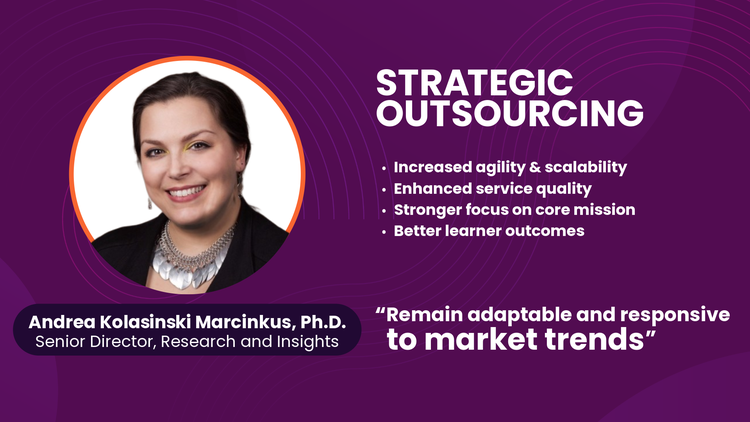
By Andrea Kolasinski Marcinkus, Ph.D., Senior Director of Research and Insights
Education institutions today face intense pressures — from rising operational costs and competitive enrollment landscapes to rapidly evolving technologies and student expectations.1 To adapt and thrive, many schools and universities are increasingly looking beyond their own walls for support.
Traditionally, outsourcing in academia was limited to non-academic functions, but that is quickly changing. Higher education institutions have long outsourced areas like bookstores or facilities; now they’re increasingly partnering with external firms for core academic services such as online program delivery, market research and strategy, student advising, enrollment management, and technology integration.2
These partnerships allow schools to leverage outside expertise and resources to improve efficiency and expand their capabilities. Delegating certain operations to specialized providers, campus leaders can concentrate on what they do best (educating students and advancing institutional goals) while experts handle the rest.
The key is to approach outsourcing not as a loss of control but as a strategic collaboration. When done right, partnering with an education management provider can increase agility, enhance service quality, and free up resources for mission-critical priorities.3

“The key is to approach outsourcing not as a loss of control but as a strategic collaboration.”
Andrea Kolasinski Marcinkus, Ph.D., Senior Director of Research and Insights
Benefits of outsourcing educational services
Outsourcing certain academic and administrative functions to an experienced external provider can offer numerous advantages for educational institutions. Below are some of the most significant benefits of outsourcing.
Cost efficiency and operational agility
Working with external partners often helps institutions save money and operate more nimbly by tapping into the partner’s economies of scale and established systems.4 Institutions often pursue outsourcing to reduce costs, improve service delivery, and address capability gaps — especially when internal teams are constrained by staffing, budget, or competing priorities. In online education specifically, online program management (OPM) arrangements have become widespread and can bundle multiple functions that institutions may find hard to staff and scale internally.5
As higher education policy expert Clare McCann noted, “The benefit to institutions seems fairly clear… it means someone else will handle the difficult process of getting these programs up and running and of growing these programs.”6 By shifting these heavy lifts to a dedicated partner, institutions can become more agile in responding to opportunities.
Enhanced focus on core mission (teaching and students)
Outsourcing time-consuming tasks allows campus leaders, faculty, and staff to refocus on their primary mission: Delivering quality education and supporting students. Instead of stretching internal teams thin with administrative burdens, an external provider can handle those processes in the background. This means in-house staff have more capacity to engage personally with students, innovate in curricula, and improve the learning experience.
Delegating support functions in this way frees institutions up to concentrate on teaching, research, and student development, ultimately leading to a higher-quality educational experience for learners.7 Crucially, when personnel can devote more attention to learners’ needs, service improves — which can boost student satisfaction and even retention rates over time. Outsourcing helps ensure that educators spend their energy where it matters most: On students and academic excellence.
Access to specialized expertise and technology
Education management providers bring deep expertise, seasoned professionals, and cutting-edge tools that many institutions would struggle to develop on their own. By partnering with an outside specialist, an institution can immediately tap into a larger talent pool with specialized skills — whether in online instructional design, digital marketing, data analytics, IT support, or student counseling. These providers invest heavily in the latest educational technology platforms, analytic systems, and best practices to stay competitive.8
Outsourcing companies can offer advanced technology and expert knowledge to enhance an institution’s capabilities and student services. In practice, this might mean access to robust online course platforms, AI-powered student engagement tools, or compliance management systems that a single college could not easily build in-house. Such expertise and infrastructure enable even small or resource-constrained schools to deliver state-of-the-art programs and support, leveling the playing field and driving innovation. This matters because the sector’s technology environment is moving quickly: Students increasingly expect access to learning “anytime, anywhere,” the use of learning analytics continues to rise, and institutions face intensifying cybersecurity and privacy considerations.9
Scalability and flexibility
Outsourcing can help institutions scale support up or down as enrollment and program portfolios change — without the same timelines and fixed costs associated with building every capability internally.10 Enrollment fluctuates, new programs launch, and old ones phase out — and an external partner can adjust the support accordingly in real time.
For instance, if a university suddenly sees a surge in online enrollment or decides to roll out a new degree program, an education management provider can quickly deploy additional enrollment advisors, tutors, or technical support staff to meet the demand. Conversely, if numbers dip, the institution isn’t left carrying excess permanent staff. This elasticity allows colleges to remain adaptable and responsive to market trends. In a fast-changing educational environment, this agility is a major strategic advantage.
Strategic areas to consider for outsourcing
With these benefits in mind, which specific functions can an education-focused institution outsource? While every institution has unique needs, there are several strategic areas in which partnering with an education management provider can be especially effective. Here are a few examples.
Market expansion research and strategic advisory
In a competitive and enrollment-constrained environment, decisions about launching new programs, entering new modalities, or expanding into new markets carry significant financial and reputational risk. Institutions are under pressure to ensure new offerings are aligned with workforce demand, student interest, and long-term sustainability.11
Outsourcing elements of market research and strategic advisory work can provide institutions with access to specialized analytic capabilities, external benchmarking, and objective assessment. External partners often bring labor market analytics, competitive landscape modeling, pricing analysis, modality feasibility assessment, and enrollment forecasting expertise that may not exist internally at scale. Research on strategic decision-making in higher education highlights the value of data-informed program portfolio management and external environmental scanning, particularly in periods of demographic and financial volatility.12
An experienced advisory partner can support institutions in evaluating new degree and certificate opportunities, conducting competitive positioning analyses, assessing modality expansion (such as online, hybrid, and accelerated formats), modeling enrollment and revenue scenarios, or aligning academic portfolios with workforce and employer demand.
Importantly, outsourcing research and advisory work does not replace institutional governance or academic leadership. Instead, it supplements internal expertise with structured analysis, third-party validation, and scalable research infrastructure. This allows campus leaders to make high-stakes program decisions with greater confidence and stronger evidence.
Online program development and delivery
Launching and managing online courses or degree programs can be resource intensive. Outsourcing elements like instructional design, learning management system administration, and online course facilitation allows institutions to expand into online education quickly.13 A partner can provide course designers, multimedia developers, and even adjunct faculty training to ensure high-quality online learning experiences that the institution might not otherwise have the capacity to support.
Student recruitment and enrollment management
Attracting and enrolling the right students is critical — and increasingly competitive. Specialized providers can take on marketing, lead generation, admissions outreach, and enrollment advising for academic programs. These are some of the most common types of third-party arrangements.14
These providers use data-driven marketing campaigns, enrollment coaching, and CRM systems to boost application numbers and yield rates. By outsourcing this function, schools benefit from professional marketing expertise and scalable admissions operations, helping them reach new demographics of learners (even globally) without overburdening their own admissions office.
Student support services and retention
Once students are enrolled, keeping them engaged and on track is paramount. Outsourcing or co-sourcing support services such as academic advising, tutoring, career counseling, and tech support can significantly enhance the student experience. External student success teams often offer 24/7 tutoring hotlines, proactive academic coaching, and early alert interventions for at-risk students. These services have a proven impact on improving student outcomes and retention.15
For example, Boundless Learning reports student retention rate, on average, at 95% in the programs they support, thanks to intensive, personalized advising.16 By partnering on student services, institutions can ensure their learners receive prompt, expert help and encouragement at all hours, something difficult to achieve with limited on-campus staff.
Educational technology and analytics
Modern education relies on sophisticated technology infrastructure — including learning management systems, virtual classroom platforms, and analytics that track student progress. Educause notes that data and analytics are a foundational driver of institutional strategy and student success, made even more pivotal by rapid AI proliferation.17 Managing and updating these systems can strain an internal IT department. An outsourced solution can provide a robust, cloud-based technology platform, technical support, and data analytics services tailored for education.
This might include virtual classroom software, content libraries, AI-driven learning analytics dashboards, and cybersecurity measures to protect student data. Handing off these technical aspects to a provider guarantees that the institution always has up-to-date tools and expertise in place. It also enables data-driven decision making: The partner can analyze enrollment trends or student performance data and provide actionable insights to the school’s leadership. In short, outsourcing EdTech operations lets institutions leverage the latest innovations without huge upfront investments or maintenance headaches.
Each institution can determine which areas are best managed externally versus in-house. The guiding principle is to outsource functions that are important but not core to the school’s identity, so that internal teams can focus on strategic priorities.
By choosing reputable partners in the above domains, colleges and universities can strengthen those functions dramatically and deliver better outcomes for learners and stakeholders.
Boundless Learning: Empowering partnerships in education
At Boundless Learning, we have seen firsthand the transformative impact that the right outsourcing partnership can have on an institution. As an education management provider with more than 30 years of experience in online learning, we’ve collaborated with universities and organizations worldwide to launch more than 450 programs and support thousands of learners.
We believe in a collaborative, mission-aligned approach
When we partner with an institution, we become an extension of their team, invested in their success. Our expert staff and innovative platforms help our partners expand capacity, enhance student services, and adapt to the future of education with confidence.
We pride ourselves on keeping learner success at the heart of everything we do, whether that means designing engaging online courses or providing dedicated student support that boosts retention and completion rates.
Boundless Learning’s team is ready to help your institution realize the benefits of outsourcing
From strategic planning and market insights to day-to-day program management and student support, we offer flexible solutions tailored to your needs. We understand the challenges educators face, and our goal is to empower your organization to reach more students and deliver exceptional learning experiences — all while relieving operational burdens.
By partnering with us, your institution can focus on its core academic mission, knowing that our seasoned professionals are handling the rest. Together, let’s design the future of learning.
About Andrea Kolasinski Marcinkus, Ph.D.: Andrea Kolasinski Marcinkus, Ph.D., is the Senior Director of Research and Insights at Boundless Learning, where she leads a global team delivering actionable insights that inform academic strategy, product innovation, and institutional growth. Partnering with universities, associations, and corporate organizations, her team analyzes market trends, learner needs, and workforce demands to help partners design educational offerings that are both competitive and learner centered.
1 See these resources:
NACUBO. (2025, Sep 8). State of Higher Education: Top 5 Business Issues of 2025. https://www.nacubo.org/Research/2025-Top-Business-Issues
Commonfund. (2025, Dec 11). 2025 Higher Education Price Index (HEPI) report released. https://www.commonfund.org/research-center/press-releases/2025-higher-education-price-index-hepi-report-released
National Student Clearinghouse Research Center. (2026). Final Fall Enrollment Trends 2025 (highlights page). https://nscresearchcenter.org/enrollment-insights/
EDUCAUSE. (2024). 2024 EDUCAUSE Horizon Report: Teaching and Learning Edition. https://www.eduq.info/xmlui/bitstream/handle/11515/39482/2024EDUCAUSE-Horizon-Report-teaching-learning-edition.pdf
2 See these resources:
Sun, J. C., Turner, H. A., & Cermak, R. (2025). Why Do Universities Outsource Management of Their Online Programs? American Journal of Distance Education. https://www.tandfonline.com/doi/pdf/10.1080/08923647.2024.2366593
U.S. Government Accountability Office (GAO). (2022). Education Needs to Strengthen Its Approach to Monitoring Colleges’ Arrangements with Online Program Managers (GAO-22-104463). https://www.gao.gov/assets/gao-22-104463.pdf
3 Hamilton, L. T., Daniels, H., Smith, C. M., & Eaton, C. (2024). The For-Profit Side of Public U: University Contracts with Online Program Managers. Socius, 10. https://journals.sagepub.com/doi/pdf/10.1177/23780231231214952
4 Marcus, J. (2021, January 8). More colleges and universities outsource services to for-profit companies. The Hechinger Report. https://hechingerreport.org/more-colleges-and-universities-outsource-services-to-for-profit-companies/
5 Gupta, A., Herath, S. K., & Mikouiza, N. C. (2005). Outsourcing in Higher Education: An Empirical Examination. International Journal of Educational Management, 19(5), 396–412. https://eric.ed.gov/?id=EJ802753
6 Marcus, J. (2021, January 8).
7 Gupta, A., Herath, S. K., & Mikouiza, N. C. (2005).
8 U.S. Government Accountability Office (GAO). (2022).; Hamilton, L. T., Daniels, H., Smith, C. M., & Eaton, C. (2024).
9 EDUCAUSE. (2024). 2024 EDUCAUSE Horizon Report: Cybersecurity and Privacy Edition. https://library.educause.edu/resources/2024/9/2024-educause-horizon-report-cybersecurity-and-privacy-edition
10 Gupta, A., Herath, S. K., & Mikouiza, N. C. (2005).; U.S. Government Accountability Office (GAO). (2022).
11 National Student Clearinghouse Research Center. (2026).; NACUBO. (2025, Sep 8).
12 EDUCAUSE Horizon Report: Teaching and Learning Edition. 2024.; Hamilton, L. T., Daniels, H., Smith, C. M., & Eaton, C. (2024).
13 Turner, H. A., et al. (2024). Financial Flows to Online Program Managers. https://files.eric.ed.gov/fulltext/ED671862.pdf
14 See these resources:
UPCEA. (2024, Aug 5). OPMs: Partners in Online Education. https://upcea.edu/opms-partners-in-online-education
U.S. Government Accountability Office (GAO). (2022).
15 Bettinger, E. P., & Baker, R. (2014). The Effects of Student Coaching: An Evaluation of a Randomized Experiment in Student Advising. Educational Evaluation and Policy Analysis, 36(1), 3-19. http://epa.sagepub.com/content/36/1/3.abstract
16 Boundless Learning. (n.d.). About Boundless Learning. https://www.boundlesslearning.com/about-us
17 Robert, J., Muscanell, N., & Arnold, K. (2025). EDUCAUSE Horizon Report: Data and Analytics Edition. https://library.educause.edu/resources/2025/10/educause-horizon-report-data-and-analytics-edition