Rethinking Online Higher Education: Insights from Kim Foxwell
Online higher education is at a turning point. As institutions navigate shifting learner expectations, emerging technologies, and global competition, the question is no longer whether online learning matters, but how to do it well.
We spoke with Kim Foxwell, Partnerships Director for Boundless Learning, about the evolving landscape of online higher education in the UK. From the role of technology and human connection to the challenges institutions face in staying competitive, Kim shares a candid perspective on what’s changing and what comes next.
I have always been connected to education, whether as a teacher, private tutor, working in the gem and jewelry sector, or in higher education itself. Every career pivot has somehow curved around into education. The other constant has been a consistent urge to create order from chaos.
Education is reaching a new inflection point, with fundamental questions being revisited about what knowledge matters, how it should be taught, and what this means for society. The traditional nursery–school–university pathway that shaped the last 30–40 years is increasingly being challenged. Online education both has driven this evolution and must now evolve itself; it is no longer a case of simply transferring written content or recording lectures but instead requires deliberate investment and clear strategic intent.
The greatest impact will come from those who successfully blend technological advances with the human connection and creation at the heart of learning. This means high-quality, well-produced content alongside space for discussion, connection, and support. However, it is not just in the delivery of academic knowledge that this impact will be seen. As online study is often a lonelier experience, pastoral and administrative support is even more critical than for those students in an on-campus setting.
The most successful models will use technology to enable personalised, individual, and genuinely human engagement with students. The trend I am seeing right now is a rapid growth in experimentation on the best ways to deliver both the education itself and the vital ancillary shell that supports it.
There is a dual problem for online education. For many, there is still the hint that online education is somehow the poor relation to its grander, more “real” on-campus counterpart, probably due to its evolution from correspondence courses. It is perceived as easier, lesser than, and this is fundamentally no longer true. Online courses are sometimes even more academically in-depth, as when designed well, they do not allow for individual students metaphorically to hide at the back of the classroom.
Taking the plunge and really embracing online education as a delivery method in itself, instead of a nice-to-have, is a big decision, especially now with such strains on finances. The challenge is to decide whether the gamble is right for the institution, but equally the risk is being left behind should it prove to be a critical part of educational infrastructure in the future.
For those who do choose to offer online education, the next challenge is how to embrace new technology without depersonalising and cheapening the learning experience of students. AI and VR are two examples that we are only just starting to grapple with, and reactions have varied from the enthusiastic to the horrified. Another is how to incorporate academic research and development into courses, and to keep them fresh and relevant, given the initial production takes more work than simply updating lecture notes.
I don’t think it’s possible to answer this question, still, without reference to covid. I was involved in online education beforehand, considering and working on at various points in my career course design, pedagogy, academic rigour, administrative processes, student experience, and perception. The pandemic meant suddenly my norm became everyone’s — and the harder parts of delivering online education well became much more evident.
Simply lifting and dumping lectures into an online format just does not work — they are very different beasts and serve very different learning styles. I believe the pandemic helped highlight this. It also led to a boom in demand, with a long tail as people began to think of work and free time differently, and with an increase in free time, there was a corresponding increase in desire to learn.
It tells us something about human nature. More time and easier access led to a notable increase in applications to online programmes, even after the pandemic subsided. However, as with any sudden behavioural shift, the curve flattened, and now we are facing such unpredictable macroeconomic and geopolitical and sociological headwinds, it is understandable that demand will drop again until the perceived value of online vs. on-campus — and indeed education itself — has been reestablished.
There are a few, but perhaps the most muddled one is that legislation has not kept up with technology in this space. Examples such as taxation on education, sanctions on individuals or countries, and the increasing politicisation of education as both a service and a public good have complicated matters significantly, as education can effectively now be accessed globally — or cut off by simply removing internet access. Of course, addressing these requires international collaboration and agreement — and public and private sectors also working together. Not an easy ask when education is justifiably seen as both a human right and a commodity for sale.
The biggest EdTech trends I see right now are centered on improving student outcomes while simplifying how institutions operate. There’s a clear shift toward AI-enabled personalisation and analytics to better support engagement, retention, and timely intervention, paired with more intentional use of AI rather than experimentation for its own sake.
At the same time, universities are moving toward modular, cloud-native platforms that integrate learning and data more effectively and reduce operational complexity. The focus is on scalable, sustainable technology that improves access and completion for learners while remaining practical and cost-effective for institutions.
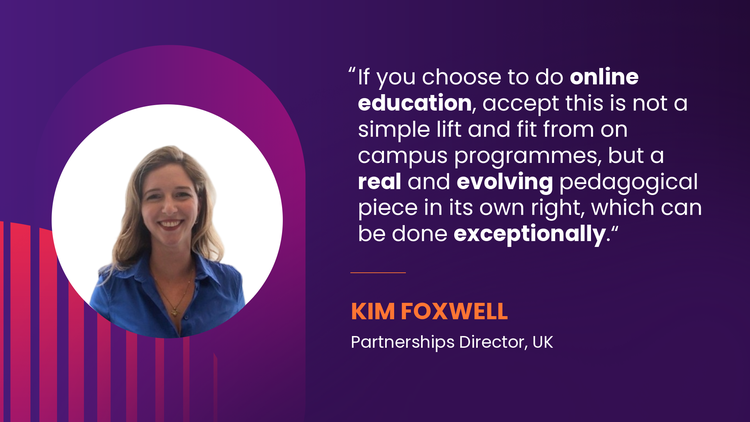
Identify exactly why your institution is valuable to the market and why someone should go there instead of anywhere else for your particular course. This may mean consolidation of programmes — and no longer being all things to all people. It may mean some really difficult and uncomfortable analysis of which submarkets the institution should be playing in. Do fewer things, but do them well. And if you choose to do online education, accept this is not a simple lift-and-fit from on-campus programmes but a real and evolving pedagogical piece in its own right, which can be done exceptionally.
It is still horribly uncomfortable for many to think of education as a business and courses as a product that needs to be designed well, packaged up, and marketed. But the truth is it has been this way for quite some time, and with access to debt increasing demand, we have veered into education as a commodity rather than simply a public good.
Everyone is talking about AI, but I think that’s the wrong question. It’s tech itself. Not long before AI, everyone was getting excited about VR. The possibilities there, especially for online education, and especially for more practical courses, are currently enormous and unplumbed. Going back to my gemmology days, if I could implement a programme or course now that allowed for VR headsets to help students learn about inclusions that allow for gemstone identification — both online and on campus — I would, and this would have been inconceivable just a decade ago. And that is niche — work is already being done in other scientific fields, including medicine and engineering. AI is just another tool we haven’t quite figured out how to use. The risk here is that it will make us unambitious and undermine the value in learning and creating for ourselves.
About Kim Foxwell: Kim is Partnerships Director (UK) for Boundless Learning, where she collaborates with universities to design and deliver high-quality, student-centered online learning experiences.
She brings extensive experience in online education operations and strategy, including senior roles at Imperial College Business School and Gem-A, the world’s longest-established provider of gemstone education. At Boundless Learning, she’s focused on helping our UK partners navigate digital transformation while maintaining a strong emphasis on human connection in learning.