Policy Pressure, AI Readiness, and Shifting Expectations: What PIE Live North America Made Clear
By Andrea Marcinkus, Ph.D., Senior Director of Research and Insights
During the first week of December, I attended the 2025 PIE Live North America conference in Chicago. I kept finding myself in the same conversation — sometimes on stage, sometimes in sessions, sometimes in the space between them. It usually started with a version of the following: Everything feels like it’s changing at once.
Policy uncertainty. Enrollment pressure. AI everywhere. Rising expectations from learners, employers, and staff — often without the systems or structures to support them.
What struck me wasn’t just the pace of change, but how consistently people were circling the same underlying question: How do we respond in a way that’s intentional, aligned, and still deeply human?
I attended PIE Live as both a panelist and a participant, and across very different sessions, a few themes surfaced again and again.
Learning from the panel: Aligning technology, education, and workforce needs
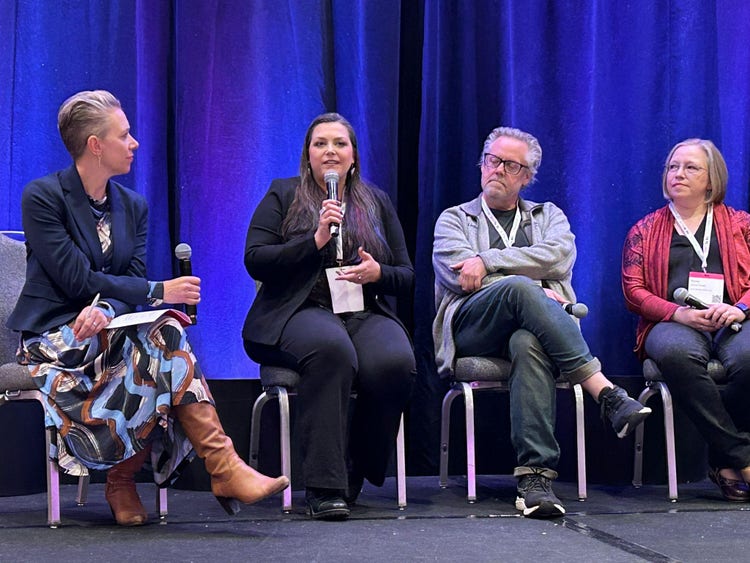
Andrea Marcinkus speaks at PIE Live. Photo credit: PIE News
I joined the main-stage panel “Future focus: how technology needs to align with education to deliver a future workforce,” moderated by Amy Baker, CEO of The PIE. I was joined by Alyssa Tormala, Head of School at Laurel Springs School; Brandon Linden, Senior Customer Success Manager at LinkedIn; and Salvatore Moccia, Head of Education and Skills at EIT Digital. The range of perspectives mattered: K–12, higher education, employers, and pan-European digital education because workforce readiness doesn’t sit in one sector, and neither does responsibility for it.
What made the conversation especially strong was how quickly it moved past surface-level enthusiasm about AI and into more practical topics: What actually supports learners, what data really tells us, and where technology helps — and where it doesn’t.
From the Boundless Learning perspective, I spoke about designing for the whole learner, not just the academic experience. Across our work, we consistently see that while academic challenge is real, it’s often not the reason learners disengage. More often, the barriers are non-academic: Work commitments, caregiving responsibilities, financial stress, mental health concerns, digital confidence, or simply not knowing where to start. If technology is going to support learners meaningfully, it has to acknowledge those realities rather than being designed around an idealized version of student life.
That led naturally into a discussion about retention and support. I was clear that we can’t automate our way out of retention or enrollment challenges. AI can be powerful in surfacing early signals — missed logins, stalled pacing, repeated confusion points — but those signals only matter if there’s a human on the other side who can interpret them with context and care. One line I came back to, which resonated strongly in the room, was this: AI should empower the people who support learners. Coaches, advisors, and faculty remain central; technology works best when it gives them better information at the right moment, rather than attempting to replace those relationships.
We also discussed how learning itself is changing. Learners are increasingly moving between full-program formats and short formats that can stack into longer programs (such as certificates, badges, and micro-credentials) over the course of their lives, often while working full time. In many cases, learners and employers value visible progress along the way, not just an endpoint credential. That has real implications for program design, assessment, and motivation. Meeting learners where they are means creating pathways that allow for momentum and recognition without sacrificing learning quality.
Another theme I raised was how we track “real” learning and engagement. Completion rates and time-on-task tell us very little on their own. What’s far more predictive are behavioral patterns: Where learners repeatedly return to content, where confusion clusters, and where navigation itself becomes a barrier. Across millions of learner interactions, we’ve seen that small points of friction — unclear instructions, hidden discussion boards, fragmented systems — are often early warning signs of disengagement. Fixing those micro-frictions early can fundamentally change outcomes.
Throughout the panel, there was strong alignment across perspectives. Brandon Linden spoke about how employer demand is shifting toward adaptable skill sets rather than static roles. Salvatore Moccia brought a European lens, emphasizing structured skills frameworks and digital ecosystems that support mobility and employability. Alyssa Tormala highlighted the importance of learner confidence and developmental support earlier in the pipeline.
Policy is no longer background noise
An emphasis on alignment showed up in the international student policy update session chaired by Amy Baker, with Cheryl Matherly (Lehigh University), Clare Overmann (AIEA), Joann Ng Hartmann (NAFSA), and Sammer Jones (University of Illinois Urbana-Champaign).
The conversation was grounded and candid. International student policy uncertainty isn’t an abstract backdrop— it’s shaping enrollment decisions, institutional risk tolerance, and the day-to-day work of international education teams. One takeaway stayed with me: Institutions can’t plan as if volatility is temporary. Strategy now needs to include scenario planning, cross-institutional collaboration, and clear communication that supports international learners and the staff serving them.
Partnership isn’t optional — it’s a leadership capability
That message carried directly into the session on strategic partnerships and leadership with Lisa Coleman, President of Adler University, and Monroe France, Strategic Advisor to the President. What stood out was how clearly partnership was framed as an operating model.
Sustainable partnerships require shared purpose, defined value exchange, governance, and trust over time. That matters because the challenges institutions are trying to solve — workforce alignment, learner wellbeing, global engagement, technology integration — don’t live in one department or with one partner. Partnership is no longer a side project; it’s becoming a core leadership capability. The most effective leaders are those who know when to partner internally versus taking advantage of external vendors that specialize in areas the university does not. These intentional partnerships are what is allowing institutions to be flexible and adapt to change quickly while maintaining growth.
Data matters — but only if it leads to decisions
The Global Enrollment Benchmark session, featuring Ashley Fitchette (Studyportals), Joann Ng Hartmann (NAFSA), and Mary Phillips (Oxford University Press), reinforced that international enrollment patterns aren’t just shifting — they’re becoming more uneven and more complex.
What I appreciated most was the focus on implications, not just trends. Data becomes powerful when it informs where institutions focus attention and redesign learner experiences — particularly for international learners navigating unfamiliar systems.
AI readiness is a systems challenge, not a tools race
Daniel Bielik’s session on AI-enabled higher education added another essential layer. Drawing on research from the Digital Education Council, he highlighted uneven AI adoption, shifting job roles, and the widening gap between industry needs and educational models.
What resonated was the emphasis on governance and readiness. Institutions that approach AI with shared language, clear guardrails, and intentional design are far better positioned than those reacting tool by tool. Speed matters, but not at the expense of learning quality, cognitive development, and trust.
A final reflection
PIE Live left me thinking less about any single innovation and more about alignment. Institutions are being asked to navigate policy pressure, enrollment shifts, partnership demands, and AI disruption — all at once.
The future workforce will need adaptability, confidence, and the ability to make sense of change. If that’s what we want learners to develop, our educational ecosystems need to model it: Connected, transparent, supportive, and intentionally human.
That, more than any individual tool or trend, feels like the work ahead.