Insights in Learner Success: How Erick Edmond Drives Student Retention
What is the secret to helping learners not just start their educational journey, but finish it? At Boundless Learning, we achieve high student retention, demonstrating effective support and engagement strategies for our partners, and our effectiveness starts with our dedicated student success teams. These professionals are the guiding force behind every learner's journey, providing the support, encouragement, and strategy needed to transform goals into achievements.
We’re excited to share a series of interviews with our directors of student success, starting with Erick Edmond. We spoke with Erick about his personal definition of student success, the proven strategies he uses to boost retention, and how data and empathy combine to create an environment in which every learner can thrive.
I hold degrees in business and psychology with specializations in marketing and exercise science, along with professional master-class certificates in leadership and executive leadership. I have over 27 years of customer service experience, including 14 years of focus on learner and educational support.
I’ve been proud to contribute as a team member within Boundless Learning for more than 13 years. I started as a program manager — which was the former title for student success advisor.
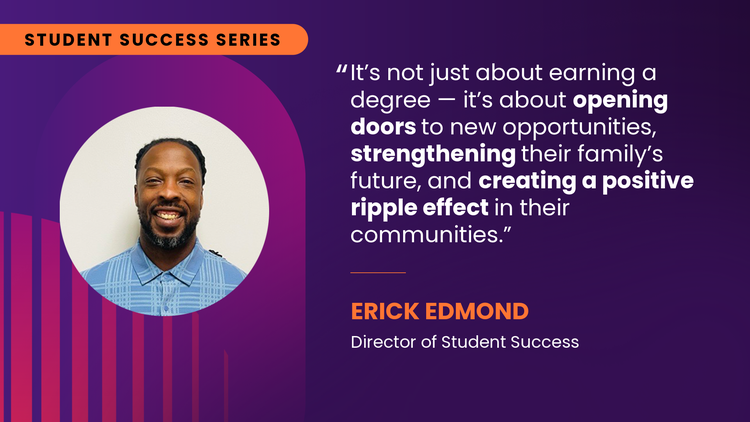
To me, student success is the transformation that occurs when a learner feels supported, empowered, and confident enough to persist through challenges and achieve their academic and personal goals. It’s not just about earning a degree — it’s about opening doors to new opportunities, strengthening their family’s future, and creating a positive ripple effect in their communities.
As an advisor, I define success through the strength of the partnership we build with students. When learners feel heard, encouraged, and guided, they are more likely to stay focused on their purpose and reach milestones that once felt out of reach.
I focus on key indicators like persistence and term-to-term retention, course completion, and overall academic progress. I also track engagement signals — timely responses, proactive outreach, and how connected the student feels. Finally, I look at goal attainment, from small personal wins to long-term graduation milestones.
One of the most effective strategies I’ve used to improve student retention is implementing proactive communication based on key points in the student journey, rather than waiting for issues to arise.
Each touchpoint had a clear purpose—checking progress, reinforcing available resources, and reconnecting students to their long-term goals. This intentional approach increased engagement, boosted on-time registrations, and reduced withdrawals by ensuring students felt supported and guided rather than navigating alone.
We noticed a drop in first-term retention, with many new learners disengaging early. I analyzed withdrawal and engagement data, then redesigned a first-term outreach to provide clearer guidance and stronger support. By collaborating with key teams and creating structured follow-up workflows, we built a system that identifies at-risk students early. As a result, retention improved over the next few terms because students were engaged sooner and connected with the right resources before slipping away.
When I identify an at-risk learner, I approach the situation with urgency, empathy, and structure. I quickly reach out through multiple channels and use open-ended, supportive conversations to understand the student’s challenges and identify the true root cause. From there, we build a clear, personalized success plan and set intentional follow-ups to ensure the student feels supported, accountable, and never alone in the process.
The goal is always to move from crisis response to a sustainable plan that helps the student feel more in control and confident about staying enrolled.
I understand that financial and personal challenges often drive students to stop out, so I begin by normalizing the conversation to create a safe space for honesty. From there, I connect them with the right resources, help adjust their academic plan if needed, and re-anchor them to their long-term goals. By pairing practical solutions with consistent emotional support and follow-up, I help learners stay enrolled in a way that feels manageable and aligned with their “why.”
I see data as a decision-making tool, not just a report. I use it to identify where to focus my time and how to adjust strategies. By combining data with human insight, I can be more targeted and effective, focusing on energy where it will have the greatest impact on learner success.
I would describe my leadership style as collaborative, coaching-focused, servant-oriented, and outcome-driven.
Collaborative: I involve the team in problem-solving, encouraging ideas from all levels and creating space for open discussion about what we’re seeing with our learners.
Coaching-focused: I prioritize regular 1:1s, strengths-based feedback, and development conversations, so each team member understands their impact and feels supported in growing their skills.
Servant leadership: I lead by serving the team — removing barriers, advocating for their needs, and ensuring they have the tools, clarity, and confidence to perform at their best. My goal is to elevate others and create an environment where they can thrive.
Outcomes-driven: I connect our daily work to clear metrics — retention, persistence, registration, and learner satisfaction — and help the team see how their efforts influence these outcomes.
I inspire teams by sharing real student success stories, making retention goals meaningful, and modeling the student-centered behaviors I expect. I also celebrate both major achievements and everyday wins to keep the team motivated, aligned, and connected to our mission.
About Erick Edmond: Erick is a seasoned leader with more than a decade of experience in higher education and a passion for learner retention and success. Prior to Boundless Learning, he worked for Pearson for 13 years. Erick holds degrees in business and psychology from Mayville State University.