Global by Design: Discussing NAFSA 2026 Highlights with Chris Heath
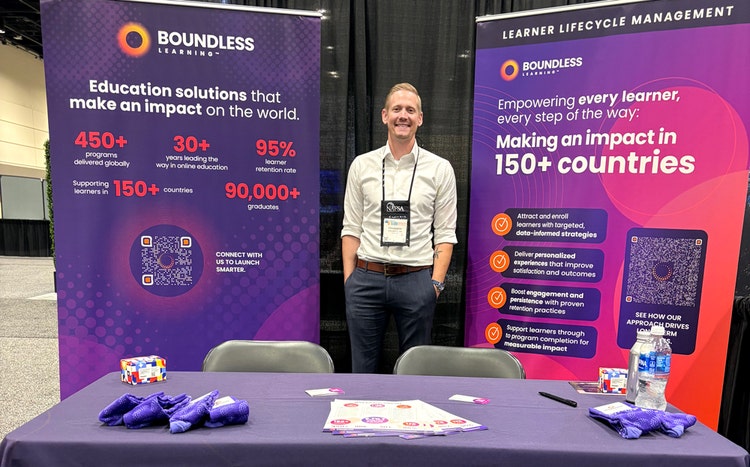
Education is global by nature. To meet the needs of today’s learners wherever they are, the future of higher education must be built with intention and collaboration. That's why the NAFSA 2026 conference, presented by NAFSA: Association of International Educators, centered on the theme “Global by Design.”
At a time when shifting visa policies, evolving learner expectations, and increased competition are reshaping the landscape, the conference challenged institutions and service providers to rethink how they work together to expand access and support learners worldwide.
Following the event, we sat down with Chris Heath to discuss key takeaways from NAFSA, and the role online education will play in the future of international learning.
"Global by design" sounds aspirational. It can also become a hollow sentiment if institutions are not honest about what it takes to execute.
From a Boundless Learning perspective, it means every layer of the student experience is intentionally built to serve learners wherever they are, not just where it is convenient for an institution to reach them. That is a fundamentally different posture than saying "we accept international applicants.”
We have seen this play out through our U.K. partnerships. Those programs attract learners from across the globe not just because of brand strength but because they were built to be delivered at a distance with real infrastructure behind them. This means early intervention when engagement drops, proactive outreach, and connecting learners to the right resources quickly.
Being global by design requires intention and investment. You do not accidentally serve a global learner population well. You build for it.
Many conversations at our booth came back to the same issue. Changes in immigration and visa policy have shaken confidence in the U.S. as a reliable destination, and institutions do not have a clear answer for how to replace that volume.
What surprised me was not the problem. Anyone paying attention knows enrollment is under pressure. What surprised me was institutions waiting to see how policy shakes out rather than building the flexible infrastructure that lets them pivot when it does.
The people showing up to NAFSA are not the ones giving up. They are the ones still trying to figure it out. That energy was encouraging.
Online education is probably the single most important tool institutions have right now for maintaining international enrollment, and I do not think everyone has absorbed that yet.
The traditional model requires a physical journey: A student gets a visa, travels to the U.S., and lives on campus. That model is facing headwinds from every direction: Visa uncertainty, cost of living, geopolitical tension, and a growing list of competing destinations.
Online education removes the visa dependency entirely. A learner in Portugal who wants a credential from a credible U.S. or U.K. institution can get it without ever sitting in an embassy waiting room.
For institutions, online program development is no longer just a domestic strategy. It is an international access strategy. That distinction matters more now than ever.
It signals that the commodity is the credential, not the geography.
The U.S., the U.K., Canada, and Australia had a comfortable lock on this market for a long time. That assumption is eroding faster than most people expected. Education quality has improved globally, cost differentials are harder to justify, and immigration policy in traditional destination countries has made the decision easier for students to look elsewhere.
When 50+ countries are competing for the same pool of mobile students, supply has caught up to demand. Students have real options now. They can weigh program quality, cost, immigration friendliness, post-study work rights, and whether the program is even available online.
The institutions that win in this environment are the ones that recognize the student has the leverage. You must earn that enrollment. A recognizable name on a brochure is no longer enough.
I genuinely believe AI is going to make this industry better. The question is whether institutions use it to enhance human judgment or replace it.
The version that excites me removes friction. A student with a financial aid question used to call an office, navigate a phone tree, wait on hold, and hope someone responded within 72 hours. That is operational drag with nothing to do with education. AI tools give accurate, specific answers immediately. That is a real improvement to the human experience.
The same can be true with at-risk identification. If AI flags a student who is falling behind before they disappear, and that alert gets a real advisor to pick up the phone faster, that is not depersonalization. That is better human intervention.
Where it goes wrong is when AI becomes a reason to eliminate human interaction in the process rather than make the humans more effective. A struggling learner who needs someone to listen to them and gets an AI agent instead has not been served. They have been processed.
The threshold is simple even if execution is not. AI handles the transactional. Humans handle the relational.
Three decades teaches you that the learner experience is not a single workflow. It is dozens of workflows that touch each other in ways that are not obvious until something breaks. Enrollment handoffs, billing questions that become retention risks, advising conversations that reveal a student is dealing with something that has nothing to do with school — those are not problems you completely automate. They are problems you solve with those who have judgment built from years inside these programs.
Fragmentation does not get fixed by adding more point solutions. It gets fixed by having a partner who understands the full arc of the student experience and is accountable for it. A startup with a compelling demo is still learning which questions to ask. After 30 years, we already know most of the answers.
Certainty. And it is in very short supply.
They need certainty that processes will be predictable. Certainty that their credential will be recognized. Certainty that if they invest significant time and money in a program, the support infrastructure will get them across the finish line.
Policy is working against that first piece. Institutions and prospective students are operating in a climate where the rules can change faster than an enrollment cycle. That is deeply destabilizing for a market built on multi-year planning horizons.
Is the industry listening? The people in the enrollment offices are listening. NAFSA was full of problem-solvers actively looking for ways to adapt.
The students choosing the U.K., Canada, Germany, or an online program over a U.S. campus right now are forming preferences that will have lasting effects on pipelines. The institutions that come out ahead will be the ones building program quality and learner support that make them the right answer regardless of what the visa environment looks like.
The future is online, accessible, and increasingly detached from the physical borders that used to define it. That is not a prediction. It is a trajectory already visible in enrollment data and in many conversations happening at conferences like NAFSA.
Our role is to help university partners get ahead of that curve rather than chase it. Through our U.K. partnerships, we are already seeing what a genuinely global online learner population looks like. It works because the programs were built for it, not retrofitted.
The opportunity we are building toward is helping institutions recognize that online program development is an international strategy. The program you build for a working adult in Dallas also serves a learner in Singapore or South Africa with the same professional goals and the same constraints on their time.
A few things stuck with me.
The concentration risk: Schools that built significant pipelines from China have already watched enrollment contract over consecutive years. Institutions heavily reliant on India are staring at forward-looking visa data that should concern them, even though India remains the top source country by volume today. That dichotomy represents two different phases of the same underlying problem. The institutions faring best built diversified recruitment strategies before the disruption hit.
I also noticed a genuine appetite for partners who do more than fill seats. Institutions want strategic relationships around program development, market positioning, and learner success. That maps directly onto how Boundless Learning thinks about our university partnerships.
The least sophisticated observation I will make is that good swag still works. Our socks were popular, and more importantly, they started conversations that would not have happened otherwise. In a trade show environment where you have 10 seconds before someone walks away, a useful and memorable giveaway beats any brochure. Consider that a pro tip from someone who just attended his first NAFSA.
About Chris Heath: As Director of Enterprise Sales at Boundless Learning, Chris brings firsthand higher education insight into every partnership conversation. With more than 20 years in the sector, he combines strategic expertise with a practitioner’s perspective. Having spent a decade working directly within universities, leading enrollment, training, and development initiatives, Chris understands what it takes to help institutions navigate change and achieve their goals. This perspective enables him to serve as a trusted advisor to partners navigating an evolving higher education landscape.