Empowering Learners Through Human Connection and Technology: Insights from Student Success UK & IE
Times Higher Education (THE) launched its new Student Success UK & IE conference in November in Edinburgh. The event brought together representatives from the public, private, and third sectors, all united by a shared focus on the student experience. Across three thematic streams — Teaching and Learning, Student Support, and Retention, Engagement, and Impact — senior leaders from across the sector shared ideas, research, case studies, and emerging best practices.
The two days were fast-paced, and the breadth of sessions created the pleasant challenge of deciding where to focus attention. The conference also included structured opportunities for private meetings, organised in a speed-networking format, enabling higher education (HE) providers and sector partners to discuss specific needs and explore collaborative approaches to common challenges.
Boundless Learning was privileged to give a talk during the conference, titled “Bridging the Gap: From Enquiry to Graduation with Care”. Presented by Director of Partnerships, Kim Foxwell, and Senior Director of Enrolment and Retention, Shireen Loonat, the talk focused on the unique and dedicated way Boundless Learning guides its students throughout the academic journey.
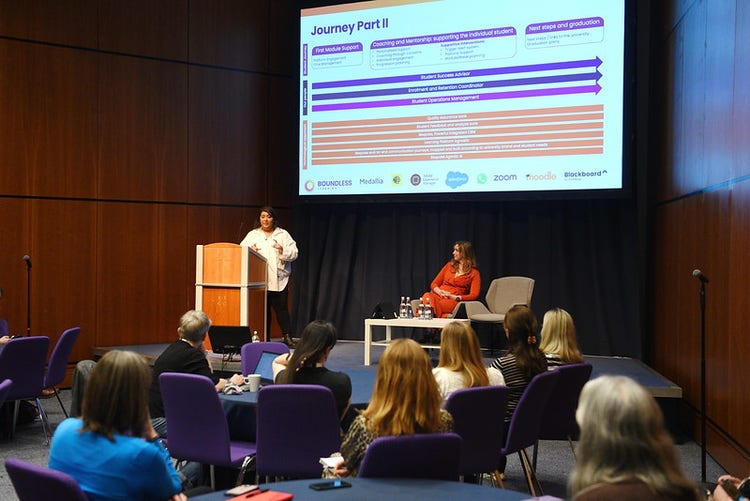
Photo courtesy of Times Higher Education.
Student retention: Online — and on campus
Throughout the conference, a surprising topic reoccured across sessions and discussions. While engagement strategies for online students has long been recognised as essential, it's increasingly clear that retention is now a growing issue for on-campus students as well.At Boundless Learning’s talk, attendees were particularly interested in the level of personalisation we provide and in the strength of the relationships our advisors build with students. This naturally led to questions about whether similar approaches could be adapted for on-campus cohorts.
Traditionally, online learners have required more formalised institutional support. The camaraderie and peer relationships that form quickly in a physical lecture theatre take longer to develop in virtual spaces; as a result, a student success advisor often becomes a vital lifeline.
Yet conversations at the conference suggested that something has shifted for campus-based learners, prompting institutions to seek more robust structures for student support across all modes of study. Understanding why this need is intensifying will require further analysis — but the pattern is unmistakable.
Our contribution: How we make the magic happen
Boundless Learning prides itself on the care we extend to every student, and at this conference, we shared both the technical foundations and human-centred philosophy that underpin our approach. As Shireen highlighted in our talk, setting a student up for success begins long before onboarding or induction.
From the moment a learner expresses interest in a programme, our advisors guide them with honesty, clarity, and care. We invest significant effort in ensuring not only that a programme is right for the student, but that it is right for them at this moment in their lives. This groundwork is as important as everything that follows in the enrolment journey.
To enable this high level of personalised support, our advisors are powered by a robust, thoughtfully designed tech stack. It allows us to meet learners where they are — whether they are tentative first-time explorers of online education or confident students ready to dive into a new academic journey.
As Kim underlined: “Technology handles the repetitive, functional tasks so that our advisors can dedicate their time to what matters most: meaningful, human connection.”
This focus on connection may seem unexpected from an online programme manager (OPM), where distance and digital delivery are inherent. But it is precisely because online learners are physically remote that we place such importance on human relationships — and on using technology to strengthen, not replace, them.
Many organisations, with the right resources, could replicate elements of our technological infrastructure. But our true differentiator lies in the interplay between our technology and our people. We design our systems to accelerate access to human support, enabling advisors to spend more time engaging in nuanced, personalised conversations that make the difference between persistence and withdrawal.