Empowered Partnerships, Mediated Delivery, and AI in Higher Ed: Thoughts and Insights from Digital Universities UK 2026
By Joël McConnell
There’s a particular energy that comes with events like Digital Universities UK that transcends the typical bounds of conference momentum, creating a sense that the sector is actively rethinking how it operates at a system level. This year’s event — held April 14-16 in Birmingham, UK, and presented by Times Higher Education — made that especially clear.
Across three days, the focus was not narrowly on online learning but on the wider transformation of universities as digital organisations employing data-backed, AI-powered solutions to enhance the student experience, operating models, and institutional strategy.
Discussing data and AI in higher ed with experts across industries
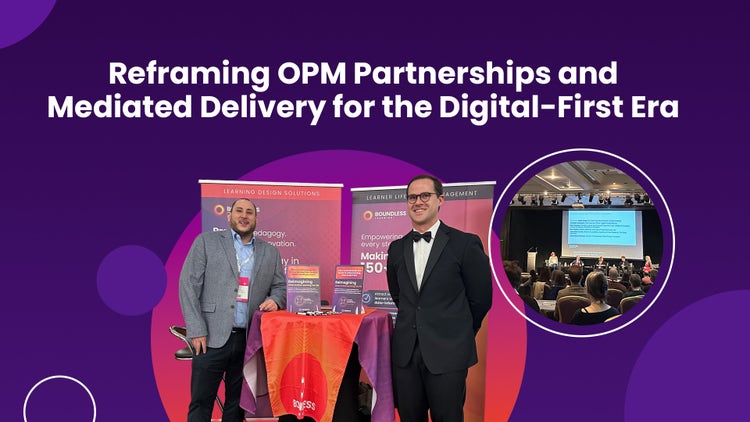
For us at Boundless Learning, the event was an opportunity to engage directly with that broader shift. I attended alongside Marc Nutt, our Director of Partner Marketing (UK), and between us we covered a wide cross-section of the agenda. Just as importantly, we spent a significant amount of time in conversation with senior higher education leaders testing ideas, comparing approaches, and understanding how institutions are navigating similar challenges in different ways.
The diversity of voices at the event reflected the scale and complexity of the transformation underway. Alongside universities, there was strong representation from organisations shaping the digital ecosystem around higher education, including OpenAI, D2L, Risepoint, TechUK, the Alan Turing Institute, and CoSector. At the same time, the institutional presence was equally broad, spanning senior leaders from across the university spectrum, including leading Russell Group institutions and The Open University, still the benchmark for online education in the UK.
What stood out immediately was how integrated the conversation has become. Digital is no longer treated as a standalone initiative. It is embedded across the institution, influencing decisions from recruitment and marketing to curriculum design, student support, and governance.
This was particularly evident in sessions focused on data and infrastructure. There is a clear push towards more connected, institution-wide data environments that can support real-time decision-making. The ambition is not simply better reporting but a more responsive, insight-led operating model. Yet many leaders were candid about the challenges: Legacy systems, fragmented ownership of data, and the difficulty of aligning multiple internal stakeholders around a shared vision.
AI was, unsurprisingly, a major theme, but the tone has shifted. The conversation has moved beyond speculative use cases towards practical application. Institutions are increasingly focused on where AI can be embedded into existing workflows to drive tangible value, whether in student recruitment, personalised support, or elements of content development. The emphasis is on augmentation rather than wholesale replacement.
Presenting on empowered partnerships and mediated delivery
It was within this broader context of institutional transformation that my own session sat. My presentation, “Reframing OPM Partnerships: Capability, Control, and the Shift to Mediated Delivery,” explored one specific dimension of that change: How universities are delivering and scaling online degree provision as part of their wider digital strategy.
The central argument is that universities are undergoing a structural migration of teaching and delivery into digital systems at scale. This is not an isolated shift, but part of a broader reconfiguration of how institutions operate.
In practice, this means delivery is increasingly mediated through a network of platforms, partners, workflows, and data systems. Universities are no longer simply delivering programmes; they are orchestrating complex ecosystems. That idea of “system orchestration” came through repeatedly across the conference, whether in discussions about CRM transformation, student lifecycle management, or digital governance.
Within that system, the role of external partners, including OPMs, continues to evolve. One of the most consistent themes in our conversations with university leaders was the tension between speed and control. Institutions are under pressure to move quickly, launching new programmes and entering new markets, while building internal capability and retaining ownership of key strategic assets.
In the session, I framed this as the “dual role” of OPMs. They enable speed to market through established infrastructure across marketing, recruitment, learning design, and operations. At the same time, they shape how delivery is configured, introducing dependencies and influencing how capability develops within the institution over time.
Partnering strategically to encourage long-term capability
What was particularly notable at Digital Universities UK was how openly this balance is now being discussed. The debate has matured. Universities are no longer asking whether to work with partners, but rather how to do so in a way that aligns with their long-term strategy.
This shift was echoed in broader discussions around operating models. There is a clear move towards more modular, flexible approaches, whether in technology, service delivery, or partnerships. Institutions are becoming more deliberate in how they assemble and manage their capabilities rather than relying on monolithic solutions.
From a Boundless Learning perspective, this aligns closely with how our own model has evolved. The focus is on enabling acceleration without long-term lock-in, supporting partners to launch and scale programmes while transferring capability over time. That balance between immediate delivery and long-term institutional development is increasingly central to the conversations we are having across the sector.
Our discussions with leaders over the three days reinforced this point. There was a noticeable level of candour around the realities of transformation. Aligning academic, operational, and commercial priorities remains complex. Governance processes can struggle to keep pace with the speed of change. And while the direction of travel is clear, the path to get there is often iterative rather than linear.
Key takeaways: Confidence, understanding, and preparation
By the end of the event, what emerged was a picture of a sector that is both more confident and more self-aware. There is a clearer understanding of the strategic importance of digital transformation alongside a more grounded view of what it takes to deliver it effectively.
For Boundless Learning, Digital Universities UK reaffirmed the role we play within that landscape. Not just as a service provider, but as a partner helping institutions navigate the interplay between strategy, capability, and execution.
If there was a single takeaway from this year’s event, it is this: Digital transformation in higher education is no longer about isolated initiatives or individual technologies. It is about how institutions redesign themselves as integrated, data-informed, and digitally enabled organisations. And the real challenge lies in orchestrating that transformation in a way that delivers both immediate impact and long-term capability.
Are you ready to prepare your institution for the future through data-backed partnerships and mediated delivery? Start here. Discover how Boundless Learning can help you deliver digital education programs that empower students to thrive and excel.
About Joël McConnell: Joël serves as Senior Director of Portfolio Management and Growth (UK) for Boundless Learning. With extensive experience on the institutional and business sides of higher education partnerships, Joël leads in digitalization projects and stakeholder engagement. He holds an MBA from IE Business School and has continued his dedication to lifelong learning through several additional postgraduate and executive programs at institutions like the University of Oxford, IMD, Chicago-Booth, and others. He currently pursues academic and professional interests in the areas of digital transformation in global higher education and the evolving relationship between OPM providers and their academic partners since the pandemic.