Designing Learning Experiences for Neurodiversity: Boundless Learning Presents at OLC Accelerate 2025
As we continue building better online learning experiences, accessibility should be among our top priorities, so it’s crucial to keep in mind the diversity of needs and preferences each learner may have.
Heather Burgbacher, Lead Learning Designer for Boundless Learning, gave a presentation on designing learning experiences for neurodiverse audiences at the Online Learning Consortium’s (OLC) Accelerate 2025 conference, held Nov. 17-20 in Orlando, Florida.
The presentation, titled “Different Minds, Better Design: Supporting Neurodiverse Learners Online,” covered design principles, practical strategies, and course audit considerations for developing and maintaining inclusively built online education programs.
“Sharing the principles of intentional course design is a chance to spark meaningful change and provide a foundation for learning environments where every student can participate fully,” Heather says. “By opening this conversation and sharing practical strategies, we empower each other to create learning spaces where every mind is valued, and every learner has the opportunity to succeed.”
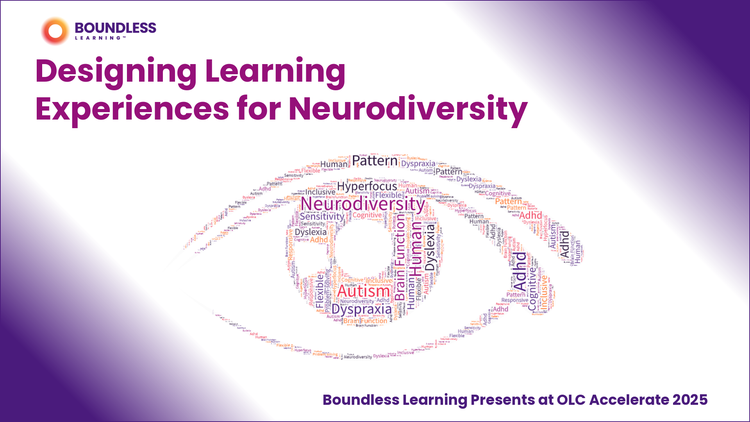
Designing for diversity
Centered around exploring the needs and challenges of different neurodiverse personas — the Visual Thinker, the Multitasker, the Wordsmith, and the Analyzer — the presentation explored the ways in which understanding and designing for neurodiversity can lead to better outcomes for all learners.
It starts with creating experiences around the principles of inclusive design: Accessibility to ensure course content reaches all learners; inclusion to help learners feel welcome and supported; and cognitive load management to prevent learners from becoming frustrated or overwhelmed.
This allows learners to build a proper foundation and expound their knowledge through relevant academic experiences, leading to stronger comprehension and development.
For the personas above, a little bit of proactive planning and inclusive design can go a long way toward achieving academic success and personal goals. Here are a few examples of how to help each learner type.
- Visual thinkers: Provide visual cues and image-based content through clear headings, relevant icons, color-coded information, and visual aids.
- Multitaskers: Encourage continued focus through engaging experiences like interactive content and shorter modules.
- Wordsmiths: Use plain language and flexibility in presentation that allows learners to study and absorb information in a format that fits their preferences.
- Analytical researchers: Focus on simplicity of design and intuitive navigation to prevent frustration and allow easy access to all needed information.
Universal Design for Learning and educational empowerment for all
One primary framework through which inclusive design can be accomplished is Universal Design for Learning (UDL), which focuses on proactive and inclusive design rather than accommodating on an individual basis. Some learning design concepts and strategies UDL promotes include the following:
- Offering information in multiple formats (text, audio, video) to account for a variety of learning types
- Presenting real-world examples and clear vocabulary that connects learning with students’ lived experiences
- Allowing flexibility in assignment and assessment formats (such as written assignments or live presentations) with opportunities for group and individual work
- Providing tools to enhance accessibility, like speech-to-text or note-taking apps, screen readers, and organizational or time management programs
“Designing for neurodiversity isn’t just about removing barriers — it’s about unlocking the full potential of every learner,” Heather says. “When we build courses that honor different ways of thinking, we create environments where all minds can thrive.”
UDL's focus on accessibility comes down to understanding neurodiversity as a natural and important aspect of human variation that should be celebrated. This means diverse learners should be empowered on terms that complement rather than detract from their unique learning styles — an approach that serves and encourages all learners, not just the neurodiverse.
By designing for diverse populations in areas like course structure, navigation, content presentation, engagement, and assessment, we can ensure more accessibility, less frustration, higher participation, and better outcomes for all learners.
Insights and takeaways from the OLC Accelerate 2025 conference
OLC Accelerate 2025 was an opportunity for education professionals of all types to come together and discuss research, practices, and solutions regarding the most pressing topics, challenges, needs, and opportunities facing education today.
Participants represented a wide array of interests and specialties, and presentations touched on education at all levels — K-12, higher education, and corporate learning and development. Themes of emphasis included the following:
- Innovative and effective digital learning design
- Leadership, partnerships, and organizational strategy
- Learner success, engagement, and empowerment
- Professional development, quality assurance, and support
“Attending OLC Accelerate 2025 was an inspiring opportunity to connect with fellow educators and innovators, explore a wide range of topics, exchange ideas, and discover new approaches to online learning,” Heather says.
She notes the following as some of the top trends and takeaways from the conference.
Developments in AI can revolutionize learning — when implemented intelligently
AI-focused sessions reflected how quickly the landscape is evolving, with discussions on new policy developments, the capabilities and limitations of emerging tools, thoughtful consideration of the ethical dimensions of AI adoption in education, and the move from generative AI to artificial general intelligence (AGI).
Strong collaboration in course development can lead to more effective design
Many sessions emphasized the importance of strong collaboration between instructional designers and faculty, highlighting effective processes such as backwards design, the Successive Approximation Model (SAM), course mapping, and onboarding strategies to support successful course development.
Fostering global community in education starts with leadership development
Several sessions were dedicated to showcasing scalable, human-centered approaches to manager development for global teams, featuring blended learning programs that foster community across roles and locations. By combining virtual instructor-led sessions, cohort discussions, microlearning, and reflective practice, these programs address real-world leadership challenges and support both academic and emotional well-being.
Working toward a better educational future for all
Many topics covered at OLC Accelerate 2025 align with Boundless Learning’s current and future goals, objectives, and mission.
Utilizing top EdTech solutions and emerging technology, intuitive and effective course development and design, and proven pedagogical approaches and practices to maximize learning effectiveness, we work with academic partners and education providers of all types to help build better education experiences.
After giving her presentation and experiencing all OLC Accelerate 2025 had to offer, Heather says she reinforced her sense of optimism about the future of accessible learning:
“I left inspired by the collective dedication of this community to making online learning engaging and robust for all.”
About the presenter
Heather Burgbacher, M.Ed., brings more than 25 years of expertise in education, blending a decade of hands-on teaching in K–12 classrooms with 15 years of leadership in instructional design. As a seasoned Lead Learning Designer, Heather excels in crafting scalable, learner-centered solutions that drive engagement and impact. She is deeply committed to mentoring teams in cutting-edge, accessible design practices — fostering innovation at every step. Heather is passionate about harnessing the power of technology to transform learning experiences, making them more engaging, inclusive, and meaningful for diverse audiences.