The Next Competitive Advantage in Higher Education: Decision Capacity
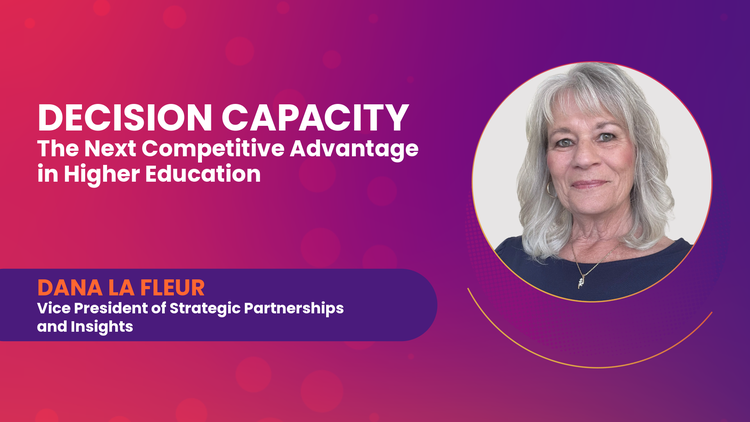
By Dana La Fleur, Vice President of Strategic Partnerships and Insights
There was one idea that consistently surfaced in conversations at this year's NACUBO Annual Meeting: The role of the university finance leader has fundamentally changed.
Today's CFOs and finance teams no longer serve simply as stewards of institutional budgets and financial reporting. They have become strategic partners in their organizations helping to navigate enrollment uncertainty and maximizing efficiencies and returns of funding models, capital planning, technology investments, workforce challenges, and long-term financial sustainability.
Managing the budget and financial reporting is still essential. But increasingly, finance leaders are being asked to answer a much more difficult question:
Where should the institution invest next?
That question isn't just financial. It's strategic.
And answering it well requires something I believe will become one of higher education's most important organizational capabilities: Decision capacity.
What is decision capacity?
Most universities don't suffer from a shortage of ideas. In fact, the opposite is often true. Every institution has an ambitious vision and a long list of initiatives that could meaningfully advance its mission. Leaders are working to improve learner success, explore the potential of artificial intelligence, modernize aging technology, address deferred maintenance, strengthen cybersecurity, expand research, launch new academic programs, and enhance the overall student experience.
None of these priorities is inherently more important than another, and each represents a legitimate investment in the institution's future.
The challenge is that while the list of opportunities continues to grow, institutional resources do not. Budgets remain constrained, and in some cases are shrinking. Leadership attention is finite. Faculty and staff capacity is limited. Every new initiative competes not only for funding but also for the people, time, and organizational focus required to make it successful.
This is where the concept of decision capacity becomes increasingly important. Decision capacity is an institution's ability to evaluate competing opportunities, understand the trade-offs between them, and consistently direct its resources toward the investments that will create the greatest long-term strategic value. It isn't simply about making decisions more quickly. It's about making better decisions — with greater confidence, closer alignment, and a clearer understanding of how today's choices shape tomorrow's outcomes.
More information isn't solving the problem
Higher education has never had greater access to information. Financial models have become more sophisticated; enrollment forecasting continues to improve, and institutions have access to an ever-expanding array of dashboards, analytics, and performance metrics. Now, with the rapid emergence of artificial intelligence, leaders can generate insights and analyze data faster than ever before.
Yet despite this unprecedented visibility, many institutions continue to struggle with one of their most fundamental challenges: Deciding where to invest next.
The reason is simple. Information doesn't eliminate complexity. It often exposes it. Better data rarely points to a single obvious answer. Instead, data reveals multiple viable paths forward, each one supported by compelling evidence and each one promising meaningful institutional impact.
For today's finance leaders, the challenge no longer is gaining visibility into the institution's performance but navigating an abundance of possibilities. As the number of worthwhile opportunities continues to grow, the real constraint becomes an institution's capacity to evaluate competing priorities, understand the trade-offs, and confidently choose where to focus its limited resources.
The strategic role of finance has expanded
One of the clearest takeaways from my conversations at NACUBO was how significantly the role of the finance leader has evolved. Today's CFOs and finance teams are no longer confined to discussions about budgets and financial stewardship. They are increasingly serving as strategic partners, helping their institutions navigate some of their most consequential decisions.
Whether collaborating with enrollment leaders to understand the financial implications of demographic shifts, working alongside academic leadership to evaluate new programs, partnering with IT on technology investments, supporting facilities teams with long-term capital planning, or advising presidents and boards on competing institutional priorities, finance has become deeply embedded in the institution's strategic decision-making process.
That represents a profound shift. The finance office is no longer simply responsible for curating and guiding financial resources; it is increasingly helping steward institutional strategy. Its role has expanded from answering "Can we afford this?" to facilitating a much more important conversation: Given everything we could do, what should we do next?
In many ways, that question sits at the heart of decision capacity. It requires institutions to look beyond individual initiatives and consider how every investment contributes to their long-term mission, financial resilience, and strategic priorities. Finance leaders are uniquely positioned to help guide those conversations — not because they have all the answers, but because they can help bring greater clarity, discipline, and alignment to the decisions that matter most.
Decision capacity creates institutional resilience
For years, conversations about financial sustainability in higher education have focused on familiar levers: Reducing costs, improving operational efficiency, and diversifying revenue streams. Those priorities remain essential, and they will continue to play a critical role in the long-term health of every institution.
But today's environment demands more.
Financial sustainability is no longer determined solely by how effectively an institution manages its resources. It is increasingly shaped by how effectively education providers decide where to invest those resources.
The institutions best positioned to navigate uncertainty over the coming decade won't necessarily be those with the largest endowments or the biggest budgets. They will be the institutions that consistently make thoughtful, disciplined decisions about where to focus their limited resources. Hallmarks of the highest-performing financial approaches will include aligning investments with institutional strategy, weighing short-term pressures against long-term outcomes, and having the confidence to say "no" to good ideas in order to invest more deeply in the right ones.
This is where decision capacity becomes a strategic advantage. It creates greater transparency around competing priorities, encourages more meaningful conversations about trade-offs before commitments are made, and fosters stronger collaboration across academic and administrative leadership. Most importantly, it builds confidence that every significant investment — whether in people, programs, technology, or infrastructure — is advancing the institution's mission and creating lasting value for learners.
AI should expand decision capacity — not replace it
There is little question that artificial intelligence will play an increasingly important role in the future of higher education. Its ability to analyze vast amounts of information, identify patterns, automate routine tasks, and model complex scenarios has the potential to change fundamentally how institutions plan, evaluate, and respond to a dynamic environment.
Yet for all of AI's capabilities, it does not replace the one thing every institution still depends on: Human judgment.
Universities are mission-driven organizations where decisions are rarely based on data alone. They require leaders to balance financial realities with academic priorities, student needs, institutional values, and long-term strategic goals. Those are not decisions an algorithm can or should make.
The institutions that extract the greatest value from AI will be the ones that use it to strengthen leadership conversations rather than replace them. AI can help leaders explore alternative scenarios, better understand the implications of different choices, and bring greater clarity to complex trade-offs. But the responsibility for making those decisions and the accountability that follows will always rest with people.
Perhaps that is the greatest opportunity AI presents within higher education: Not to automate institutional leadership but to expand an institution's decision capacity. By providing deeper insight, surfacing possibilities that might otherwise be overlooked, and enabling more informed collaboration, AI has the potential to help leaders make better strategic decisions with greater confidence. In the end, that may prove to be far more valuable than automation alone.
Looking ahead
As I reflected on the conversations at the NACUBO Annual Meeting, one message stood out above all others: The expectations placed on university finance leaders have fundamentally changed. They are no longer being asked simply to manage budgets or safeguard financial resources. They are helping their institutions navigate uncertainty, evaluate competing priorities, and make strategic decisions that will shape their future.
That shift is why decision capacity matters.
Universities have never lacked ambition, innovative ideas, or dedicated leaders. What they increasingly face is the challenge of choosing among many worthy opportunities, each competing for the same limited financial resources, institutional capacity, and leadership attention. In an environment where almost every initiative has merit, the ability to prioritize thoughtfully becomes just as important as the ability to execute effectively.
The institutions that will thrive over the next decade will not be those that simply collect more data, build more dashboards, or generate more reports. They will be the ones that cultivate the organizational capability to make consistently better decisions — aligning investments with strategy, balancing short-term demands with long-term outcomes, and ensuring that every significant commitment advances their mission.
That is the essence of decision capacity.
As higher education continues to evolve, I believe we will spend less time asking whether institutions have enough information and more time asking whether they have the capacity to turn that information into sound decisions. Because in an increasingly complex world, an institution's greatest competitive advantage may not be the size of its budget or the sophistication of its technology, but its ability to make better decisions than anyone else.
About Dana La Fleur: Dana brings more than 20 years of EdTech leadership experience across organizations including Pearson, Bridgepoint Education, and Kaplan Professional Schools. As Vice President of Strategic Partnerships and Insights at Boundless Learning, she leads the development and activation of high-impact partnerships that drive growth, innovation, and value for academic collaborators. She focuses on aligning market insights with partnership strategy to identify new opportunities, shape service models, and deliver solutions that respond to the evolving needs of higher education.