Consistency in Communication: How Claraine Croasdale Guides Student Success
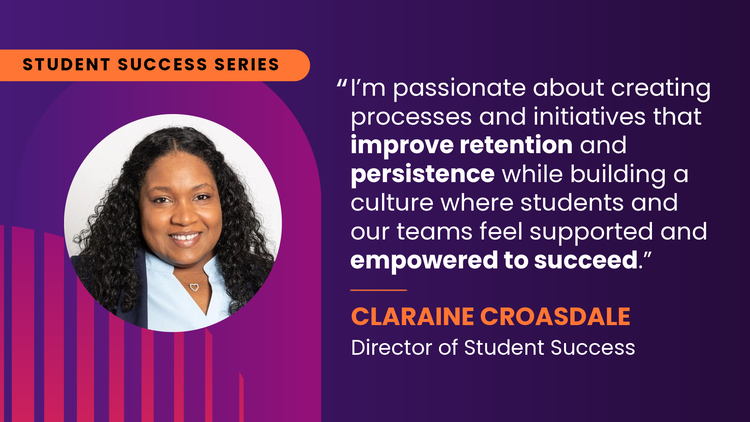
Behind every learner journey is a team of dedicated professionals who combine strategy, empathy, and innovation to help students overcome challenges and achieve their goals. These leaders play a pivotal role in fostering persistence and retention, ensuring every learner feels supported and empowered.
In this interview, we’re proud to feature Claraine Croasdale, Director of Student Success. Claraine shares her approach to defining and measuring student success and the strategies she’s implemented to improve retention. Utilizing tactics like proactive communication plans and data-driven interventions, Claraine exemplifies how thoughtful, learner-centered practices and strong, focused leadership can create lasting impacts on academic outcomes.
My background blends psychology with a passion for organizational development and student engagement. I earned my bachelor's in psychology from the University of Central Florida and later completed my master's in organizational behavior and human resources at Abilene Christian University. Those experiences gave me a strong understanding of people and how organizations work, which has been so valuable in my career.
I started with the company as an enrollment coordinator, where I learned how important that first interaction is for a student’s journey. After about a year, I moved into the student success team as an advisor, and that’s where I really found my passion. I loved building relationships with students, helping them overcome challenges, and celebrating their wins. During that time, I also developed skills in data analytics and communication, learning how to use data to improve outcomes while adapting to different student needs.
After a couple of years, I stepped into a manager-level role, which gave me the chance to support and grow a team. That’s where I started combining leadership with strategy. In June 2022, I became Director of Student Success, and now I get to influence things on a bigger scale. I’m passionate about creating processes and initiatives that improve retention and persistence while building a culture where students and our teams feel supported and empowered to succeed.
Student success, to me, is fundamentally about persistence and progression. It’s not just about completing a single term successfully, but about maintaining momentum term over term and year over year until learners achieve their academic goals. Persistence reflects a student’s ability to overcome challenges and stay engaged in their educational journey.
To measure this, we prioritize retention and completion metrics, which we track through our reporting system in Tableau. This tool enables us to visualize trends across terms, identify patterns in student engagement, and calculate retention rates. By analyzing these trends, we can proactively address barriers to success and implement strategies that support continuous enrollment and eventual program completion.
Beyond persistence, we also consider course trends such as course completion or drop rates. These help us understand not only whether students are staying enrolled, but whether they might need additional resources or support.
One effective strategy we have used to improve student retention is the implementation of proactive communication plans. These plans leverage phone calls, emails, and text messages to ensure students receive critical information at the right time. They also provide motivation during points in the academic journey that tends to be more rigorous.
In addition, we utilize key success indicators that reflect the needs of our learners at critical stages. This approach helps us identify risk factors early and remove barriers that could hinder progress. By streamlining communications and committing continuous improvement, we have seen a positive impact on retention.
For example, with one of our academic partners, we developed a detailed registration process that we continuously refine by adding new data points. This allows us to better understand student needs and deliver targeted communication to the right groups, ensuring timely support and guidance.
We identified courses where students historically struggle due to challenging content. To address this, my team developed a plan to place students entering those courses into a high-priority status and created a detailed communication strategy to layer in additional support. This approach allowed us to closely monitor their progress and tailor outreach to their specific needs, ensuring timely interventions and a more personalized experience.
When we identify an at-risk learner, our first step is to act quickly and intentionally. We begin by reviewing the data points that flagged the risk, such as missed assignments, low engagement, or changes in enrollment behavior. This helps us understand the root cause and tailor our approach.
Next, we initiate personalized outreach through phone, email, or text to connect with the student and assess their situation. The goal is to listen, identify barriers, and provide immediate resources or solutions. This could include encouraging them to connect with their instructors for academic support, use time management tools, or take advantage of financial counseling — or connecting them with specialized services.
We also document the interaction and set up follow-up checkpoints to ensure progress. In some cases, we collaborate with faculty or other departments to create a holistic support plan. Our focus is always on removing obstacles and empowering the student to regain momentum in their academic journey.
When tackling barriers to retention such as financial challenges or personal struggles, we start by identifying the issue early through proactive outreach and data monitoring. Once we recognize a potential barrier, we engage the student in a personalized conversation to understand their specific circumstances. This allows us to provide targeted resources and solutions.
For financial challenges, we connect students with financial aid advisors and payment plan options to reduce stress and keep them enrolled. For personal struggles, we leverage the institutions network of support services, such as counseling, tutoring, and time management resources, to help students regain balance.
We also maintain consistent follow-up to ensure the student feels supported throughout the process. Our goal is to remove obstacles and create a clear path forward so students can focus on achieving their academic goals.
We really lean on data to guide our retention strategies. We keep an eye on key metrics like persistence, course performance, and engagement so we can spot trends and catch risks early. For example, if the data shows certain courses have higher withdrawal rates, we flag those students and put extra support in place. Using predictive insights alongside real-time monitoring helps us act quickly, personalize outreach, and keep improving our approach.
I’d describe my leadership style as a mix of servant and transformational. I focus on supporting my team by removing obstacles and making sure they have the tools and resources they need to succeed. At the same time, I try to inspire them by connecting their work to the bigger picture — helping students persist and reach their goals.
To keep retention a priority, I share data that shows the impact of their efforts, celebrate wins, and encourage new ideas. I want my team to feel empowered and know that their work truly makes a difference. For me, it’s about leading by example and creating a culture where student success is something we all own together.
About Claraine Croasdale: Claraine is an empathetic, skilled leader with more than 17 years of experience working with learners. Claraine holds a bachelor’s degree in psychology and a master’s degree in organizational behavior and human resources.