‘Built to Last’: Discussing Program Growth, Longevity, and Outcomes with Chris Barley
Partnerships in higher education aren’t one size fits all, and the most successful ones tend to focus on factors like intentionality and purpose, long-term strategy and growth, and — above all — learner support and success.
Christopher Barley, Senior Vice President of Partnerships and Growth, recently traveled to Manchester, U.K., to network and discuss these topics and more with higher education leaders and practitioners at the Higher Education Partnership Network (HEPN) North 2026 conference. He also presented on sustainability, learner success, and program growth pathways in digital education.
We spoke with Chris about his presentation — and about how strong partnerships help education providers build and manage online academic programs that are beneficial to the university, the partner, and the learners they serve. Check out his insights below.
Our approach starts with understanding what a university is trying to accomplish — not just in terms of enrollment numbers but in terms of their mission, their learners, and the outcomes they want to drive. From there, we build around that vision.
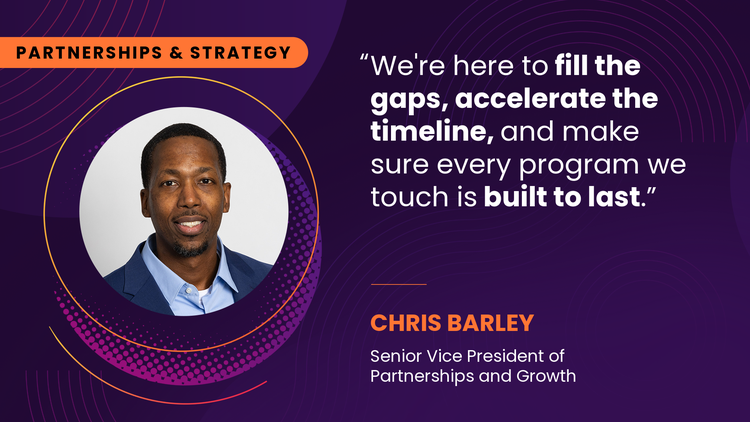
That means bringing together market research, curriculum design, learner acquisition, and ongoing student support under one partnership — in a way that respects and amplifies what the institution already does well. We're not here to replace what universities are great at. We're here to fill the gaps, accelerate the timeline, and make sure every program we touch is built to last.
Each pathway has its own rhythm and its own set of considerations, so there’s no answer or solution that will fit every circumstance. They all have their use cases.
With greenfield new builds, you have the exciting opportunity to create something from scratch — full creative latitude, strong alignment from day one, and the ability to design for today's learner. The challenge is that it takes time and investment. You're building infrastructure, brand awareness, and an audience simultaneously. It's a longer runway to breakeven, so both parties need to be aligned on patience and commitment.
Digitally ready programs, which are programs that exist in some form but haven't been fully translated to an online format, are in many ways the sweet spot. The academic content is proven, faculty are engaged, and there's often existing demand. With these partnerships, the work is really about translating that experience thoughtfully and building out the support infrastructure around it. The challenge here is managing faculty expectations and making sure the digital version doesn't feel like a lesser version of the on-campus experience.
Existing online programs that need a refresh or a boost are where you can move fastest. The foundation is there. The question is usually around optimization: Better marketing, stronger retention, smarter data use. The challenge is that sometimes there are embedded habits or structures that need to change, and change management within an institution can be just as complex as building something new.
Building and sustaining a high-quality online program is genuinely hard work, and it's work that spans a lot of different disciplines. You need expertise in marketing, technology, instructional design, student support, data analytics, and more. Most universities, even large ones, don't have all of those capabilities fully developed in-house, and that's not a criticism — it's just the reality of where higher education has historically focused its resources.
What a strong partnership does is fill those gaps without forcing the institution to hire and build everything from scratch. That matters for a few reasons. First, it's faster. Second, it's more cost-effective, especially in the early stages when enrollment is still building and the budget for full-time hires is limited. And third, it protects your team. Faculty and staff burnout is real, and asking people to take on unfamiliar responsibilities on top of their existing workload is a recipe for frustration and turnover.
The best partnerships aren't about dependency. They're about building institutional capacity over time while delivering results in the near term.
I always say that transparency upfront saves a lot of pain later. There are a few things every institution should go into a partnership with clear eyes about.
First, timeline and investment. Quality online programs don't become profitable overnight. There's a build period, a ramp period, and then a growth period. Understanding that arc — and having leadership aligned on it — is critical. Partnerships that struggle often do so because expectations weren't set properly at the start.
Second, roles and responsibilities. A good partnership agreement is specific about who owns what. Academic content and faculty relationships belong to the institution. Marketing strategy, technology infrastructure, and student support operations may sit more with the partner. But those lines need to be drawn clearly and revisited regularly.
Third, data access and transparency. You should always know how your programs are performing. Enrollment numbers, persistence rates, learner satisfaction — that data should be shared openly and consistently. A partner that isn't transparent with data isn't a real partner.
Program portfolio strategy is one of the most underappreciated levers in online education, and it's something I love talking about. Most institutions think about programs one at a time: Is this program viable? Does it have demand? And that's important. But when you zoom out and think about the portfolio as a whole, you unlock a different level of strategic thinking.
Strong portfolios are built around workforce alignment. What do employers actually need? Where are the skill gaps in the market? When your programs answer those questions, demand tends to follow. But beyond that, there are real synergies to be found across a portfolio. A learner who completes a certificate might be a natural candidate for a full degree program. Programs in adjacent fields can share marketing spend, faculty resources, and brand equity.
The institutions that win in online education over the long term aren't necessarily the ones with the most programs. They're often the ones with the most coherent and strategically aligned portfolios.
Enrollment gets all the attention, but honestly, it's just the beginning of the story. A full cohort that doesn't persist to completion isn't a success — for the learner or the institution.
The metrics I care most about are persistence, completion rates, and learner outcomes. Are students finishing what they started? Are they getting jobs, promotions, or the skills they came for? Are withdrawal rates trending down over time? Are we seeing repeat engagement — learners coming back for additional credentials?
On the partnership side, I also look at relationship health. Are both parties communicating openly? Are we solving problems together or pointing fingers when things get hard? The best partnerships I've been part of are ones where both sides feel genuinely invested in each other's success.
I genuinely believe that student success is the most underutilized financial lever in online education. Institutions spend enormous resources on marketing and recruitment, but the ROI on retaining a learner who's already enrolled is significantly higher than acquiring a new one. Yet support often gets treated as a cost center rather than a growth driver.
At Boundless Learning, we approach learner support as a proactive practice, not a reactive one. That means building strong advisor relationships from day one, using data to identify at-risk students before they disengage, and creating triggered interventions that feel personal rather than automated. A student who feels seen and supported is far more likely to persist — and far more likely to become a brand advocate who refers others.
The human element matters enormously here. Technology can flag a problem, but it takes a real person having a real conversation to solve it. Our advisors are trained not just to handle logistics but to genuinely connect with learners and help them navigate the challenges of being an adult student balancing school, work, and life.
AI is one of the most exciting tools we have right now, and I think the key word is augment. The institutions and partners that will get the most out of AI are the ones that use it to make their people smarter and faster — not to replace the human judgment and relationships that actually drive outcomes.
In market research, AI can process enormous amounts of labor market data, competitive intelligence, and learner behavior signals in a fraction of the time it used to take. That means faster, more confident decisions about which programs to build.
In program development, AI can assist with content creation, accessibility checks, and curriculum gap analysis — freeing up faculty to focus on the high-value intellectual work only they can do.
In learner acquisition and support, AI-powered chat and nudge systems can handle routine questions and touchpoints at scale, making sure no learner falls through the cracks — while escalating the complex, emotional, or high-stakes conversations to a human advisor.
And in long-term program maintenance, AI helps us stay ahead of the curve — identifying when a program is starting to show signs of declining demand or engagement, so we can intervene early rather than react late.
The throughline in all of this is that AI works best when it's in service of a human strategy, not a substitute for one.
After years in this space, a few things consistently show up in the partnerships that really work.
Shared ownership of outcomes. The best partnerships don't have a vendor and a client — they have two organizations that both feel accountable for results. When enrollment is down, both sides are at the table asking why and figuring out what to do next. That shared accountability changes everything.
Willingness to pivot. The market moves fast. Learner expectations shift. What worked two years ago may not work today. The programs and partnerships that succeed long-term are the ones that treat strategy as a living document — reviewing data regularly and making adjustments without ego.
Investment in the learner relationship. Every decision should trace back to the question: Does this make the learner experience better? Institutions and partners that keep that as their north star tend to build programs that last.
And finally, trust built through transparency. Share the data. Have the hard conversations early. Celebrate wins together. The partnerships I've seen fail almost always had a communication breakdown at their roots, while the ones that thrive are built on a foundation of honesty and mutual respect.
About Chris Barley: Chris has more than 15 years of experience building and leading enrollment departments. As Senior Vice President of Partnerships and Growth for Boundless Learning, he plays a pivotal role in strengthening partner relationships and advancing growth strategy.
Chris has extensive experience in enrollment, operations, call center, data and analytics, and product and performance management. Chris has a transformational leadership style, leading with emotional intelligence, high energy, and a passion for helping team members fulfill their potential. He holds a B.S in Business Management.