Building the Future of Learning: A Conversation with Erwin Llereza on Scaling for Student Success
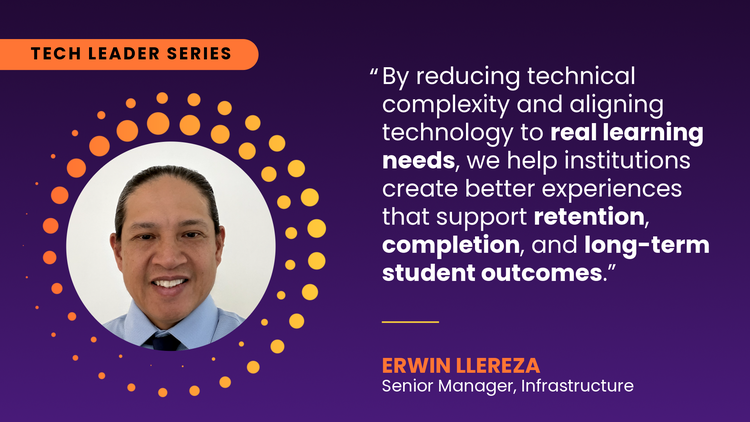
Meet Erwin Llereza, Senior Manager, Infrastructure at Boundless Learning. With nearly three decades of experience in the EdTech sector, Erwin has dedicated his career to building and evolving the technology platforms that power modern learning. His expertise lies in creating scalable, reliable, and secure systems that support long-term growth and enhance the educational experience.
Erwin shared his vision for how technology can transform higher education, the crucial role data plays in shaping strategy, and how Boundless Learning is helping institutions overcome today's most pressing technical challenges.
I’ve been in EdTech for almost 30 years. My background is in building and evolving technology platforms that support scale, reliability, and long-term business growth. I’ve spent my career working across engineering, devops, and product teams, helping organizations modernize legacy systems and transition to cloud-native architectures while maintaining stability, security, and cost discipline.
Over time, I became increasingly involved in large-scale platform transformations, particularly within digital learning ecosystems. This included modernizing learning management systems, web platforms, and enterprise infrastructure, as well as leading migrations to AWS-based environments, Adobe Edge Delivery Services, and Moodle-based LMS solutions. These experiences strengthened my focus on performance, compliance, governance, multi-region delivery, and reinforced the importance of aligning technical decisions with business outcomes.
What ultimately led me to my current position in technology was a combination of hands-on technical experience and collaborative leadership. I’ve consistently worked at the intersection of strategy and execution — bringing together internal teams and external partners to deliver complex initiatives, optimize platforms, and build sustainable technical capability. Today, my role centers on enabling growth through reliable, scalable platforms while mentoring teams and fostering continuous improvement across the organization.
My vision for technology in higher education — and at Boundless Learning in particular — is to create flexible, scalable platforms that support modern SaaS models, enable lifelong learning, and foster successful careers for students and faculty.
As higher education works to serve increasingly diverse learners and evolving workforce needs, technology must move beyond rigid, one-size-fits-all systems. At Boundless Learning, I see an opportunity to deliver cloud-native, modular platforms that strengthen how and what learners are engaging with — through personalization, multiple learning pathways, and seamless access for both educators and students. These platforms also create the foundation for new, AI-driven products that enhance instruction, improve engagement, and adapt learning experiences in real time.
By focusing on reliability, performance, and compliance as foundational elements, we can reduce operational complexity for institutions while enabling more inclusive learning experiences. When technology is used to remove barriers rather than create them, it levels the playing field for all types of learners — giving every individual the opportunity to grow, adapt, and succeed in a future-ready learning environment.
Data plays a central role in shaping my technology strategy and decision-making process, particularly when it comes to performance, scalability, and student success. I use data from across the ecosystem including web platforms, learning systems, cloud infrastructure, and analytics — to understand how technology is performing at scale and how that performance impacts learner and faculty experiences.
By closely monitoring application performance, reliability, and usage patterns alongside learner engagement and outcomes, we can design enterprise platforms that scale confidently without degrading the learning experience. Performance data helps ensure that as platforms grow — supporting more users, programs, and institutions — they remain fast, reliable, and accessible, which is critical to both institutional trust and student success.
Ultimately, data allows us to make informed, student-centered decisions while building scalable, enterprise-ready platforms. It enables continuous optimization, supports long-term growth, and ensures that technology investments improve learning outcomes while meeting the demands of complex, large-scale higher education environments.
One example that stands out is when data revealed that a significant portion of our web traffic and inbound leads didn’t align with expected user behavior. By digging into web analytics, CRM lead data, and engagement patterns, we discovered that roughly 20% to 30% of inbound requests were fake or malicious. These requests were getting through existing lead collection tools, creating noise in our data and placing unnecessary strain on marketing, sales, and engineering teams.
Once the data made the issue clear, we shifted our approach and implemented a more intelligent traffic detection solution. That decision immediately improved lead quality, restored confidence in our analytics, and eliminated a large amount of manual review across teams. It also reinforced the importance of treating data quality as a shared responsibility across technology and business functions.
One of the biggest challenges when implementing new technology is balancing innovation with stability. In higher education, systems must remain reliable, secure, and compliant, even as expectations around personalization, scale, and speed continue to grow.
Another challenge is avoiding the temptation to use technology — or AI — simply because it’s available. I’m intentional about ensuring we’re not introducing tools to “fix” a problem without fully understanding the root cause, or adding solutions that create more complexity, cost, or operational overhead than value. Every implementation needs a clear purpose, measurable outcomes, and alignment with both user needs and long-term strategy.
I address these challenges through strong change management and thoughtful execution — bringing stakeholders in early, using data to validate decisions, and rolling out solutions incrementally. By focusing on practical use cases, modular architecture, and continuous feedback, we’re able to adopt new technology in a way that drives adoption, minimizes risk, and delivers meaningful impact without creating unintended consequences.
Institutions face challenges with fragmented technology that can slow innovation and create barriers for students. When systems are hard to use or unreliable, it directly impacts engagement, access, and ultimately student success.
Boundless Learning helps overcome this by modernizing platforms in a thoughtful, data-driven way — focusing on solutions that improve accessibility, reliability, and personalization for learners. By reducing technical complexity and aligning technology to real learning needs, we help institutions create better experiences that support retention, completion, and long-term student outcomes.
The biggest EdTech trends I see right now are centered on improving student outcomes while simplifying how institutions operate. There’s a clear shift toward AI-enabled personalization and analytics to better support engagement, retention, and timely intervention, paired with more intentional use of AI rather than experimentation for its own sake.
At the same time, universities are moving toward modular, cloud-native platforms that integrate learning and data more effectively and reduce operational complexity. The focus is on scalable, sustainable technology that improves access and completion for learners while remaining practical and cost-effective for institutions.
I foster a culture of innovation by encouraging my teams to think differently and challenge how things are done today, while staying focused on solving real problems. I want solutions to feel natural to how people work and engage with technology, not forced or disruptive for the sake of change.
I create space for learning, experimentation, and ownership, and I push teams to start small, use data to guide decisions, and iterate quickly. By pairing trust with clear expectations and a human-centered approach, teams are able to grow their skills and deliver practical improvements that scale and have lasting impact.
About Erwin Llereza: Erwin is an experienced product manager with a nearly 30-year track record working in the higher education industry. He has strong product management professional skilled in product management, user experience, systems administration, quality assurance, and vendor management. Prior to Boundless Learning, Erwin worked at Pearson and McGraw-Hill.