Better Operations and Stronger Outcomes: A Conversation with Sarah Suraci on Improving Experiences with Tech-Forward Solutions
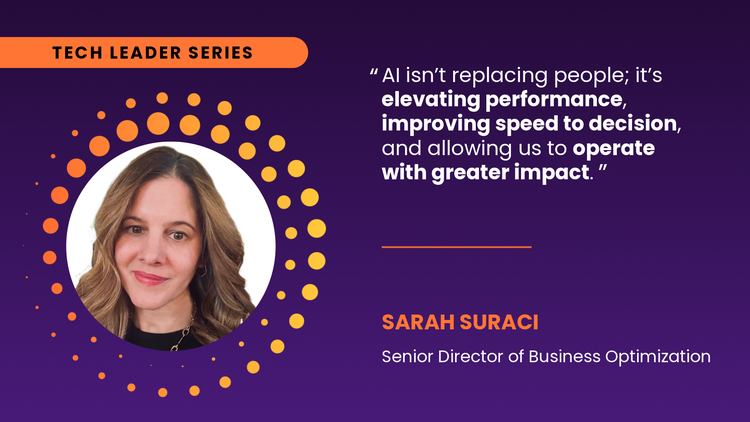
Meet Sarah Suraci, Senior Director of Business Optimization for Boundless Learning. For nearly a decade, Sarah has helped streamline and enhance our strategy and operation across a variety of roles in recruitment and enrollment, product management, and business optimization.
Through her signature blend of people skills, process, and tech experience, she works cross-functionally with leaders throughout the organization to solve complex problems, helping strengthen business results and build better learner experiences. She keeps her focus on the future, always preparing her team and the organization for what’s next in optimization.
“Innovation doesn’t typically happen by accident,” she says.
Read more about her process, expertise, and expectations for the future.
My career path definitely has not been a straight line. Before moving to Arizona, I worked in my family’s computer networking and software development business. This gave me an early understanding of technology. I started working as an enrollment advisor once I moved. I was drawn to people, hearing their stories and understanding their “why.” I’ve always been motivated by challenges and never took a role I already knew how to do. I was fortunate to quickly advance into leadership. Stepping into complex environments, building teams, and figuring out how to turn ambiguity into clarity drives me. I led faculty services and shifted the culture to a performance-based, student-centric model, then expanded into additional areas of academic operations, gaining a full perspective from recruitment and faculty delivery through graduation.
When I joined [Boundless Learning predecessor] Pearson, I returned to enrollment leadership. Not long after, I found myself pulled back toward technology and operations, moving into a product manager role for our Salesforce instance where I served as a bridge between business strategy and technology execution. Today, in business optimization, I’m able to blend people, process, and technology. That is what I enjoy most: Solving complex problems and making them simple, scalable, and impactful.
There really isn’t a “typical” day, which is part of what I love about the role. My time is split between strategic alignment and operational execution, ensuring our projects and optimization efforts are directly supporting our company’s priorities. I spend a good portion of my day partnering with cross-functional leaders to remove blockers, build momentum, and drive operational discipline to improve the employee and student experiences and strengthen business results.
I start by ensuring every initiative ties back to learner impact and business value, which are core to our mission. We align our roadmap and optimization efforts to initiatives that improve learner outcomes, increase partner transparency, and enable scalable, tech-forward solutions. We operationalize this by prioritizing work that drives measurable impact through improved decision making, AI-enabled insights, or more efficient delivery models.
Data helps us go from assumptions to informed decision-making. Improvement opportunities typically surface as I look for patterns and gaps between expected outcomes and actual results. A key focus in CIP this year is driving clear outcomes and measurable impact. We’re prioritizing initiatives with defined success metrics and a clear ROI so we can objectively assess what’s working and what isn’t. By combining quantitative data with qualitative feedback, we ensure we’re solving the right problems, and that allows us to continuously refine how we deliver value at scale.
Technology is a critical enabler to how we scale our current operation and attract new business. I guess you could say it is a strategic lever that allows us to create consistent, high-quality experiences for our staff, students, and partners through automation, AI-enablement, and integrated systems.
These all play a part in improving the service we provide, collaboration, and decision-making. When implemented thoughtfully, technology doesn’t just make operations faster; it makes them smarter, more scalable, and more aligned to delivering measurable outcomes for our partners and learners. More importantly, it strengthens our market position by demonstrating innovation, building trust, and reinforcing our credibility as industry leaders. Our expertise allows us to deliver outcomes that many institutions could not achieve on their own.
When teams understand how their work connects to shared outcomes, alignment becomes much more natural and eliminates silos. It shifts conversations from “my project” to “our impact.” Specifically for CIP, we have designed a solid governance structure, regular intake and project review meetings, and bi-weekly communications ensuring all departments have a seat at the table and their voice represented. I am lucky to work with very talented people who have brilliant minds and are a pleasure to spend time collaborating with.
Innovation doesn’t typically happen by accident. I encourage innovation by creating space for collaboration, experimentation, observation, and reflection. I emphasize continuous improvement over perfection and speed. Testing ideas, measuring outcomes, and iterating quickly allows us to build a culture where learning is valued, curiosity is encouraged, and innovation becomes a natural part of how we operate.
Innovation doesn’t typically happen by accident. I encourage innovation by creating space for collaboration, experimentation, observation, and reflection. I emphasize continuous improvement over perfection and speed. Testing ideas, measuring outcomes, and iterating quickly allows us to build a culture where learning is valued, curiosity is encouraged, and innovation becomes a natural part of how we operate.
Education and technology are evolving quicker than ever before, so while we have a clear direction, we need to take a nimble and quick approach in how we get there. I try not to plan so far ahead that we lose flexibility. This year, my focus is on supporting growth in a sustainable and scalable way, reimagining how we approach knowledge management, and thoughtfully enabling AI across the organization. Ultimately, I aim to build operational capabilities that are smart, adaptable, and continuously improving, so we are leading change — not just reacting to it.
About Sarah Suraci: Sarah Suraci is the Senior Director of Business Optimization for Boundless Learning, bringing more than 20 years of experience in higher education. Throughout her career, she has served in leadership roles across enrollment, academic operations, and business optimization, building a deep understanding of how strategy, technology, and academic excellence intersect to transform the learner experience. She is passionate about aligning people, processes, and technology to drive measurable impacts and continuous improvement. Sarah lives in Scottsdale, Arizona, and works out of Boundless Learning’s Chandler location.