The Most Human Endeavor: Amplifying Human Support in Higher Ed Through AI Capabilities
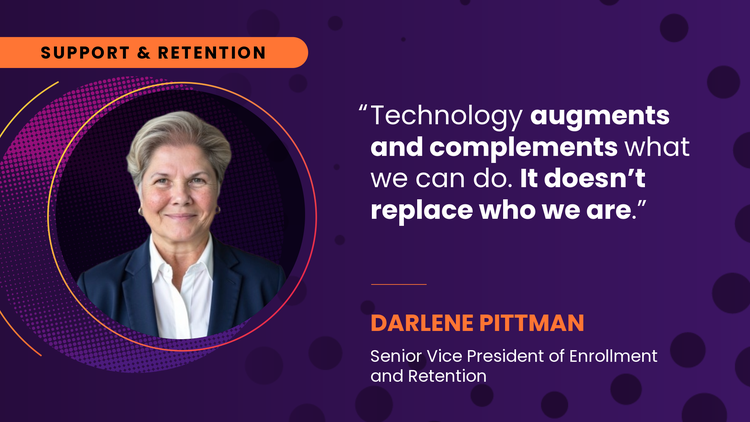
By Darlene Pittman, Senior Vice President of Enrollment and Retention
Key takeaways about AI in higher education learner support:
- Trends in hiring point toward the importance of human connection and interaction for building workplace skills and succeeding in education.
- AI has the potential to transform how we approach education, but human interventions and understanding will always be a relevant and crucial aspect of support.
- AI can be particularly useful for lower-stakes learner interactions at scale, detecting patterns, anticipating risk, and streamlining administrative processes.
- Higher education will always be a profoundly human endeavor.
Recent research from the Federal Reserve Bank of New York challenges the assumption that AI is driving the hiring squeeze for recent college graduates. Instead, the findings highlight the post-pandemic rise of remote work as a key factor contributing to fewer entry-level opportunities.
The issue isn’t widespread job replacement by AI. It’s that many early-career professionals are missing the interpersonal experiences that have traditionally shaped career growth: Mentorship, peer learning, and the informal interactions where development often takes root.
Put simply, human connection still matters, no matter how quickly technology advances.
AI with a human touch: Amplifying the future of education
That insight is especially relevant as higher education responds to the rapid expansion of AI. Institutions are being called to integrate AI capabilities across teaching, operations, and the student experience. In areas like recruitment, enrollment, and student support, AI is increasingly viewed as a scalable and efficient alternative to historically human-driven work — or a way to complement and augment teams’ abilities.
The appeal is clear.
As large language models grow more advanced, it’s easy to envision a fully integrated ecosystem of always-on, highly personalized agents delivering seamless, on-demand support to prospective and current students. In theory, AI could guide learners from initial interest through enrollment and beyond with speed, consistency, and precision.
And that vision holds promise.
Some of the functions AI can serve in education support include:
- Broadening access to information
- Accelerating response times
- Identifying patterns across large datasets
- Surfacing insights that might otherwise be missed
In many respects, it allows institutions to operate with a level of responsiveness and scale that was previously out of reach.
What it cannot fully replicate, however, is the human ability to interpret nuance, respond with empathy, and cultivate trust over time.
Keeping support, service, and connection at the heart of learner interactions
We’ve seen this pattern across industries. In fields like healthcare, financial advising, and customer experience — where human interaction is essential — organizations that initially pursued full automation have shifted course. The most successful models don’t replace people; they combine technology with human judgment to enhance outcomes.
Higher education is no exception. If anything, the stakes are higher.
Enrollment is not a simple transaction. It’s a deeply personal decision, often made during times of change or uncertainty. For adult learners in particular, it sits at the intersection of career goals, financial considerations, family responsibilities, and personal identity.
That level of complexity rarely follows a straight path.
At Boundless Learning, we see this every day. The learners we serve are managing careers, households, and evolving priorities while pursuing their education. Their journeys are dynamic plans, where obstacles arise, and circumstances change.
In those moments, access to information isn’t enough. What matters is having someone who understands their situation and can help them move forward.
This is where human connection becomes indispensable.
Experience and intuition are required to recognize what lies beneath a conversation — the hesitation behind a question, the pressure reflected in a scheduling request, the unspoken concern about persistence. Translating those signals into meaningful support demands empathy, judgment, and creativity.
That level of understanding cannot be fully automated.
Stronger service through augmented human connection
The focus on human connection is also central to why Boundless Learning has achieved and sustained a 95% retention rate among the adult learners we serve. That outcome isn’t driven by efficiency alone — it reflects a deliberate approach through which AI amplifies our ability to support learners without replacing the relationships that sustain them.
The purposeful implementation of AI as an augmentation of human intervention empowers us to do better work serving learners when they most need support.
Some of the most useful applications of AI we’ve discovered include the following:
- Detecting patterns and anticipating risk
- Personalizing outreach at scale
- Streamlining the enrollment experience
But at critical moments, there is always a human involved — someone who can listen, interpret context, and respond in a way that reflects each learner’s reality.
Maintaining that balance is essential.
As the New York Fed research underscores, even in a technology-driven world, it’s mentorship, connection, and understanding that ultimately shape success.
Prepare for an AI-enabled future: Efficiency, insights, and reach powered by human empathy
Society has long wrestled with the implications of new technologies. From early industrialization to the digital era, innovation is often framed as a threat to human relevance.
Yet history consistently points to a different conclusion: Technology augments and complements what we can do. It doesn’t replace who we are.
AI enables us to transform vast amounts of data into actionable insights. It allows us to move faster, extend our reach, and operate more efficiently than ever before. But insight without empathy is incomplete, and efficiency without connection cannot endure.
Education, at its core, is about transformation — and transformation is deeply human.
That’s why, even as we embrace AI’s potential, we remain grounded in a simple belief: The future of higher education will not be defined by how much we automate, but by how thoughtfully we integrate technology with the irreplaceable value of human connection.
Because at its heart, education remains — and will always be — a profoundly human endeavor.
Are you ready to learn how human-powered, AI-enabled support can help your institution’s learners succeed at scale? Start here. Discover how Boundless Learning empowers learners across the whole lifecycle — from application through completion.
About Darlene Pittman: Darlene’s career in higher education spans more than 15 years building and leading teams in student support and retention management. Serving as our Senior Vice President of Enrollment and Retention, Darlene combines our approach to enrollment and retention to strengthen performance across the full student lifecycle. She understands the value of excellent guidance, employing a servant leadership style bolstered by her passion for leading by example. Darlene has a B.S. in Business Administration from the University of North Carolina at Asheville, where she was a scholarship athlete and played basketball.