- Can you tell us a little about your background and role at Boundless Learning?
- Can you explain how your team ensures high-quality training across Boundless Learning?
- How do you see artificial intelligence transforming training and education in the next five years?
- If you could give one piece of advice to aspiring training directors, what would it be?
Voice of a Leader: Melanie Steppi

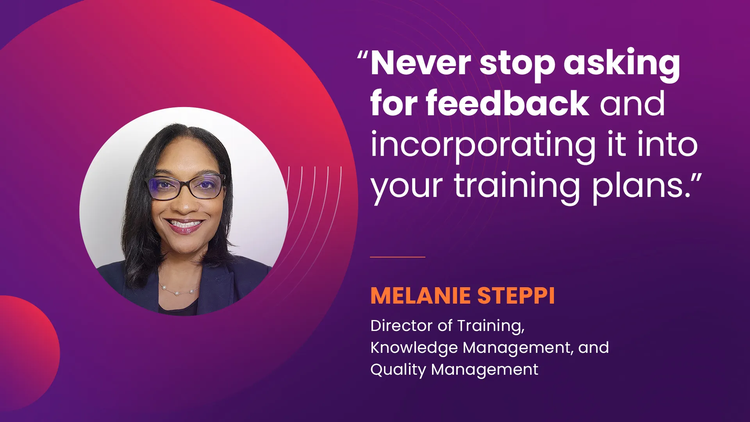
Meet Melanie Steppi, Director of Training, Knowledge Management, and Quality Management at Boundless Learning. With over a decade of experience in the training field, Melanie is an accomplished and trusted leader in facilitating global employee development.
Melanie joined us to share her unique perspective on leading the training function, the potential impacts of AI, and the advice she’d give to aspiring training directors.
Key takeaways:
- High-quality training starts with stakeholder analysis, the right modality, and continuous feedback via surveys and focus groups.
- AI will reduce manual tasks in training creation such as content reviews and accessibility checks, making processes more agile.
- In broader education, AI will accelerate research aggregation, especially in medical and language fields.
- Serious governance and regulation discussions around AI use are essential.
- Aspiring training directors should never stop asking for feedback and iterating on their plans.
Can you tell us a little about your background and role at Boundless Learning?
“Before I joined Boundless Learning, I worked in higher education in compliance, accreditation, and K-12 environments. I taught for several years in the K-12 space, focusing on teaching gifted students and students with cognitive processing disorders and intellectual disabilities.
I joined the company in August of 2013. I’ve held roles of increasing importance, and I am now the Director of Training, Knowledge, and Quality Management, in which I manage three teams focused on training, coaching, and employee development.”
Can you explain how your team ensures high-quality training across Boundless Learning?
“My team ensures high-quality training by completing analysis sessions with the primary stakeholder before building content and determining the correct training modality.
Additionally, once we fully understand the training need and expected outcomes, our team can match modalities, technologies, and blended content design to build the desired training to present the best learning experience for attendees.
Outside of requested training from our internal groups, we also complete focus groups with employees to learn what training styles or modalities work best. We deploy post-training surveys in each session, which allows us to reflect on data provided directly by the participants.”
How do you see artificial intelligence transforming training and education in the next five years?
“This is an interesting question. In regard to AI and the training industry, the first impact will be the incorporation of AI to reduce many manual tasks associated with creating, implementing, and deploying training sessions through courses or virtual instructor-led sessions.
For example, a few essential manual tasks that a trainer could expedite through AI are tasks like content reviews, accessibility checks, and easily adding visual images that are beneficial in creating and deploying training projects. This would be a game changer and make training creation more agile and streamlined.
As for the world of education overall, AI's impact seems limitless. The apparent effect is the ability to aggregate multiple sources of information and research, which should accelerate the ability of students, professors, and researchers to move faster when researching topics. I believe the immediate areas of benefit will be medical and language education.
Another prediction is that serious AI governance and regulation conversations must happen collectively with technology companies, governments, and educators regarding acceptable usage.”
If you could give one piece of advice to aspiring training directors, what would it be?
“This might be my favorite question. The simple answer is to never stop asking for feedback and incorporating it into your training plans.
The field of training is an enablement discipline. When we do our job well as training directors, we build learning ecosystems for the needs of the employees we support, and the only way to know those needs is to ask them and iterate often.”