- Rethinking Digital Education Partnerships
- Building sustainable digital education capacity in higher education
- Digital education is an operating model challenge
- Moving beyond the ‘build-or-buy’ debate
- From supplier relationships to capability partnerships
- The 4 stages of the capability development cycle
- Capability building across the learner lifecycle
- Governance as a strategic enabler: 5 critical elements of successful governance
- Key takeaways for building successful partnerships in today’s higher education landscape
- A different measure of success
Beyond ‘Build or Buy’: Rethinking Digital Education Partnerships
Universities are navigating a period of unprecedented complexity. Financial pressures, rapidly evolving technologies, increasing learner expectations, and growing operational demands are converging to create a fundamental challenge: Not simply how to adopt new technologies, but how to build the capabilities required to thrive in a continuously changing environment.
At this year's Education Strategy Forum and the Higher Education Partnership Network South 2026 conference, Boundless Learning explored why digital transformation in higher education is increasingly an operating model challenge rather than a technology challenge.
Drawing on practical experience across the sector, our session examined how institutions can move beyond traditional "build or buy" decisions and instead take a more nuanced approach to capability development. The most successful institutions are not asking whether everything should be done internally or externally. They are asking which capabilities should be built, where specialist expertise should be leveraged, and how partnerships can accelerate learning rather than create dependency.
A central theme of the discussion is that sustainable growth depends on more than delivery. It requires intentional capability development across strategy, portfolio management, recruitment, learner support, analytics, technology, and operational governance. Partnerships are most effective when they enable institutions to achieve immediate outcomes while simultaneously strengthening their ability to make informed decisions and drive future performance independently.
The session also explored how governance, transparency, shared accountability, and knowledge transfer can transform supplier relationships into strategic partnerships that create lasting institutional value.
For universities considering how to scale, optimize, or transform their digital education operations, the conversation offered a practical framework for thinking about capability development in an increasingly interconnected higher education ecosystem.
Capability-centered partnerships: Building sustainable digital education capacity in higher education
The conversation around digital transformation in higher education is changing.
For many years, discussions centered on technology adoption, outsourcing models, and the familiar question of whether institutions should build capabilities themselves or acquire them through external providers. Yet as universities respond to mounting financial pressures, changing learner expectations, advances in artificial intelligence, increasing competition, and growing demands for organizational agility, a different question is emerging.
The real challenge is not simply access to capability. It is how institutions develop, sustain, and continuously evolve capability over time.
Digital education is an operating model challenge
Universities today operate within highly interconnected environments. Strategy, portfolio planning, curriculum design, technology, marketing, recruitment, enrollment, learner support, retention, analytics, and continuous improvement are no longer discrete functions that can be optimized independently. They form part of a wider learner ecosystem in which actions and decisions in one area influence outcomes across many others.
From a learner's perspective, there is only one institution. Learners do not experience separate departments, disconnected systems, or individual suppliers. They experience a single journey. When ownership becomes fragmented, data is disconnected, or decisions are made in isolation, performance can suffer even when individual departments are functioning effectively.
Moving beyond the ‘build-or-buy’ debate
The traditional build-versus-buy framework remains useful but no longer reflects the complexity of modern higher education operating environments.
A more productive question is how institutions assemble capability at the pace required to achieve their strategic ambitions. Some capabilities may be core to institutional identity and therefore best developed internally. Others may benefit from specialist solutions that deliver efficiency, scale, consistency, or speed. Still others may require institutions to borrow expertise, capacity, or technology from partners while deliberately learning through that relationship.
This broader perspective introduces two additional considerations: Borrowing and learning.
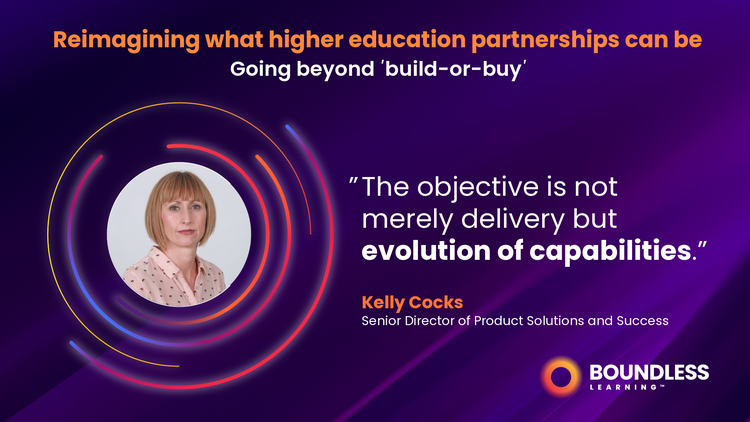
Borrowing allows institutions to access specialist expertise that would be difficult or inefficient to develop internally. Learning ensures that engagement with external partners strengthens institutional capability rather than creating long-term dependency. The objective is not merely delivery but evolution of capabilities.
From supplier relationships to capability partnerships
Partnerships exist on a continuum.
At one end are traditional vendor relationships focused on delivering defined services against agreed requirements. At the other are strategic capability partnerships characterized by shared accountability, joint problem-solving, transparency, and intentional capability development.
Challenges often arise when expectations are misaligned. Institutions may seek transformation from relationships designed primarily for service delivery, while providers may attempt strategic engagement without the governance structures required to support it.
A capability partnership begins by understanding the institution's context. Rather than prescribing services, it starts with challenges and outcomes. Whether the need is launching a new portfolio, accelerating growth, improving learner conversion, integrating fragmented systems, or pursuing broader organizational transformation, the partnership model should reflect the institution's starting point and ambitions.
The 4 stages of the capability development cycle
A useful framework for capability-centered partnerships can be summarized through four stages: Diagnose, design, deliver, and develop.
- Diagnose establishes a shared understanding of performance, constraints, opportunities, and institutional priorities.
- Design defines desired outcomes, operating models, and governance structures, as well as the capabilities that require development.
- Deliver brings together partner expertise and institutional knowledge to achieve agreed objectives.
- Develop ensures knowledge, processes, skills and confidence become embedded within the institution, enabling long-term sustainability.
This final stage is particularly important. Genuine transformation occurs not when activities are completed but when institutions become increasingly capable of repeating, adapting, and improving those activities independently.
Capability building across the learner lifecycle
Capability development can occur across every stage of the learner journey.
Institutions seeking portfolio growth may require immediate support through market analysis, demand assessment, and portfolio prioritization. Yet the longer-term objective should be strengthening the institution's ability to make evidence-informed portfolio decisions on an ongoing basis.
Similarly, recruitment and conversion initiatives may begin with optimization of marketing performance, lead nurturing, and conversion pathways. Over time, however, capability development should enable institutional teams to understand underlying performance drivers and apply insights independently.
In each case, sustainable value emerges when specialist expertise and institutional knowledge are combined through a process of co-creation rather than delivered through a "black box" model.
Governance as a strategic enabler: 5 critical elements of successful governance
One of the most significant themes emerging across the sector is the renewed importance of governance.
Effective governance is often misunderstood as additional meetings, reporting requirements, or administrative oversight. In reality, governance serves as the operating discipline that aligns institutions and partners around common objectives, enables timely decision-making, and supports continuous improvement.
Five elements appear particularly important:
- Shared outcomes
- Clear accountability
- Transparent data
- Joint governance
- Deliberate capability transfer
Together, these create the conditions for effective collaboration and measurable progress. They also help ensure that partnerships remain focused on institutional outcomes rather than individual organizational priorities.
As universities increasingly engage with multi-supplier ecosystems, governance becomes essential for maintaining quality, alignment, and institutional control across the learner experience.
Key takeaways for building successful partnerships in today’s higher education landscape
University needs and expectations are changing as higher education faces new challenges, technological disruption, and opportunities. Here’s what that means in terms of partnership.
- Universities must think beyond the “build-or-buy” partnership framework and include at least two more options: Borrow and learn.
- The most successful partnerships today have some focus on building capabilities, not renting solutions forever.
- The capability development cycle includes four steps: Diagnose, design, deliver, and develop.
- Shared governance is crucial for a successful partnership. This means collective focus on outcomes, accountability, data, governance, and capability transfer.
A different measure of success
Perhaps the most significant implication of a capability-centered approach is that success must be measured differently.
Traditional metrics such as enrollment growth, conversion performance, and retention remain important. However, they tell only part of the story. Equally important is the extent to which an institution becomes more capable over time: Better able to interpret data, make informed decisions, optimize operations, and lead future initiatives with confidence.
This perspective reframes the purpose of partnership. The goal is not simply external delivery. It is the creation of enduring institutional capability that remains long after a specific program, project, or initiative has concluded.
In an environment defined by continual change, that capability may prove to be the most valuable asset of all.