- Describe your background and what led you to your current role in student success.
- How do you personally define student success, and what metrics do you prioritize to measure it?
- Can you give an example of an effective strategy you’ve used to improve student retention?
- Can you describe a time when you successfully turned around a declining retention rate? What steps did you take?
- How do you intervene when you identify an at-risk learner?
- How do you tackle barriers to retention, like financial challenges or personal struggles?
- How do you leverage data and analytics to inform your retention strategies?
- How would you describe your leadership style, and how do you inspire your teams to prioritize retention?
Empowering Learner Success: How Megan Prince Leads with Care

At Boundless Learning, learner success is at the heart of everything we do. Our student success teams empathetically guide learners from their first class to graduation, offering the support and strategies needed to achieve all their goals.
Megan Prince, Director of Student Success, is a passionate leader in this field. We spoke with Megan about her career journey, her approach to empowering learners, and the strategies she uses to remove barriers to education. Her insights highlight the impact of care, collaboration, and data-driven solutions on educational experiences.
Key takeaways:
- Megan defines success as supporting each student’s individual goals and removing barriers to persistence.
- Metrics combine retention rates by term/course/program with qualitative student feedback.
- Effective retention strategies involve trusted advising, root-cause analysis, and recommendations to partner schools.
- Turning around declines starts with data analysis, outreach, clear expectations, and closed-loop monitoring.
- All online learners are treated as potentially at risk, so proactive relationship-building is essential.
- Leadership emphasizes listening, removing obstacles, continuous learning, and celebrating impact.
Describe your background and what led you to your current role in student success.
Twenty-one years ago, I applied for a role as an academic advisor. When asked why I was interested, I reflected on my own college experience. I only met with my advisor when I initiated the meeting to get my schedule approved, and even then, I was once misadvised, which caused me to retake a course. That experience sparked a passion for helping students succeed in their degree programs, and it was enough to land me the job.
What I didn’t expect was how much I would love it. I enjoyed conversations with students about their goals and the steps to achieve them. My favorite part was helping them create plans when things didn’t go as expected. Moving into management allowed me to influence even more student journeys. My new passion became removing barriers for my team and for our students.
How do you personally define student success, and what metrics do you prioritize to measure it?
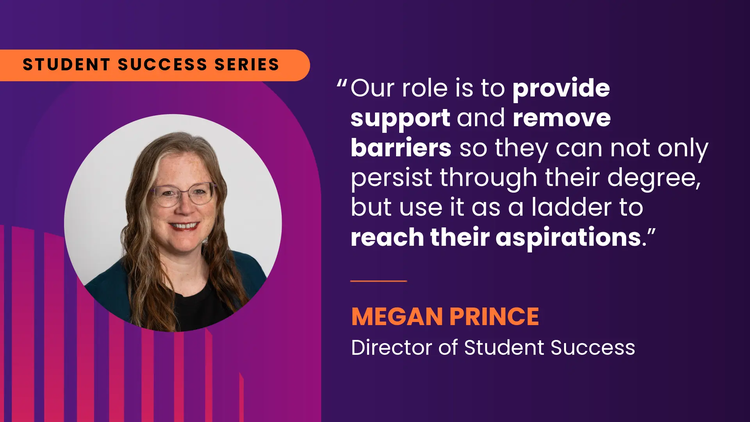
Student success looks different for every individual. It starts with understanding each student’s goals and ensuring they know we are backing them. Our role is to provide support and remove barriers so they can not only persist through their degree, but use it as a ladder to reach their aspirations.
To measure success, we look at retention rates by term, course, and program. We pair this quantitative data with qualitative feedback from students to identify opportunities for improvement and make recommendations to our partner institutions.
Can you give an example of an effective strategy you’ve used to improve student retention?
Can you describe a time when you successfully turned around a declining retention rate? What steps did you take?
We started by analyzing the data to identify where students were getting stuck, then dug in to why. This involved outreach and feedback from student success coaches and collaboration with instructors. Once we pinpointed the issue, we set clear expectations with students, helped them prepare for challenging points in the program, and worked with instructors to communicate best practices. We monitored results and closed the loop with all stakeholders.
A student’s success is often a matter of preparation. Sometimes they don’t know what to expect, and sometimes they can’t anticipate what’s coming. Either way, we’re here to help them see that short-term challenges shouldn’t derail long-term goals.
How do you intervene when you identify an at-risk learner?
In truth, all students are at risk, especially online learners who juggle jobs, family, and a rigorous program. That’s why proactive communication and relationship-building are critical. Think about a time when everything fell apart. Who was the first person you called? We want to be that person. Maybe not before a family member or best friend, but right after.
To earn that trust, we can’t just be the person who helps with scheduling. We need to listen without judgment and help create a plan that works for the individual.
How do you tackle barriers to retention, like financial challenges or personal struggles?
How do you leverage data and analytics to inform your retention strategies?
How would you describe your leadership style, and how do you inspire your teams to prioritize retention?
I start by listening and understanding. I can’t support my team effectively without knowing their day-to-day realities, their successes, and their challenges. My role is to remove obstacles so they can do their jobs well.
We also prioritize continuous learning through skill enhancement and sharing best practices. Student success isn’t one-size-fits-all; it’s individualized for each student and coach. Our training reflects that. We have a talented, tenured team, and their collaboration in training and teaching is key to elevating our work.
Finally, we make it fun. Inspiration comes from loving what we do and seeing the impact. Highlighting success stories helps the team see their influence and fuels their desire to help students succeed.